


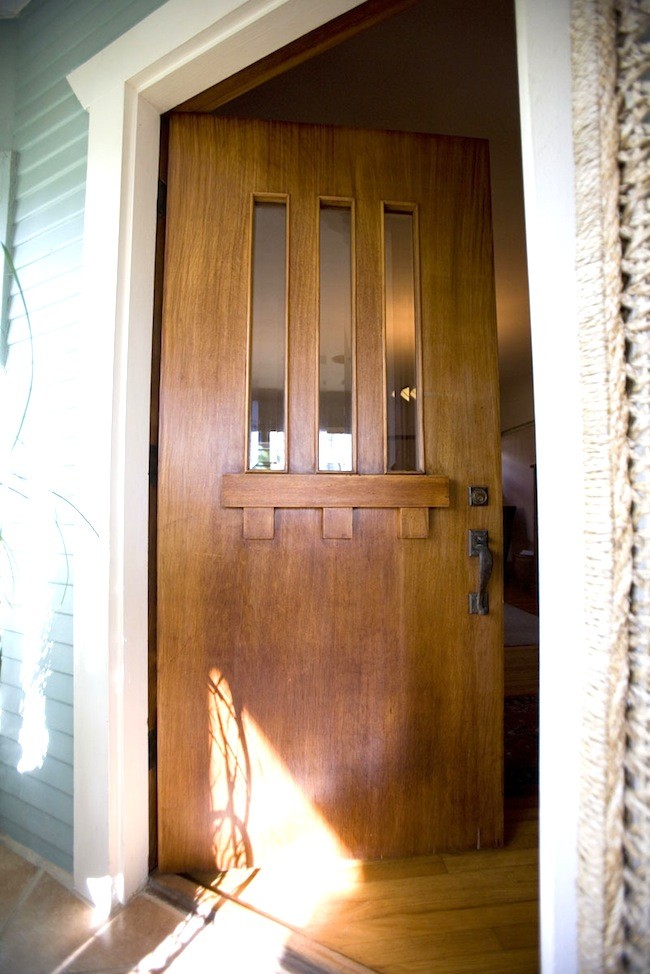
Maintaining your front door is a never-ending story
By Michael Good | House Calls
I receive more questions from readers about front doors than any other topic. Hardly a day goes by when I don’t talk to someone about their front door, text someone about their front door, email someone about their front door, telephone someone about their front door, get down on my knees and examine someone’s front door, photograph someone’s front door, research someone’s front door or repair and refinish someone’s front door. If I want to relax and go for a walk, I inevitably see a front door that needs some attention. Sometimes it’s mine.

Of course, I’ve written about front doors, too. The first column I wrote for Uptown News touched on the topic. You’d think I’d be done with doors by now. But new questions keep coming up. And old questions keep getting re-asked. I’d really like to close the door on the subject. But you know how that goes: When one door closes, another opens.
That’s a solid wood door, right?
Front doors are subjected to a pretty harsh environment: rain, fog, cats, dogs, car exhaust, road dust, sunlight, ultraviolet light, heat, cold, oxygen and people. It’s not quite as detrimental as lying on the forest floor covered with moss, but it’s close.
If your front door was built from a single slice of a tree, it would soon warp, check, crack and crumble—just like a log in the woods. To make it dimensionally stable and allow the wood to expand and contract, it’s built of rails (the horizontal pieces), stiles (the vertical pieces) and panels (you know what those are). The whole thing is held together by mortises, tenons, pegs and animal hide glue. It was built in a factory with machinery that is still in use today.
Even if the door appears to be a solid piece of wood—if it looks like a single flat panel with perhaps a speakeasy opening in the upper portion—it still is made of rails and stiles covered with a plywood skin and an approximately quarter-inch thick veneer. It may also be built of small blocks of wood that are glued together.
Why is the outside of my door oak and the inside gumwood?
Using veneers enabled the door designers to achieve various effects such as book-matching, tiger striping and quarter sawing. Veneers also gave door designers the opportunity to mix woods, matching the inside of the door to the formal rooms and the outside to whatever they wanted.
Designers took the opportunity to express themselves with front doors, and they were manufactured in a wide variety of styles and woods—Douglas fir, pine, Redwood, white oak, yellow birch, red gum and Philippine mahogany—both here in San Diego and around the country. Your door was selected specifically for your house, but it could have been built anywhere.
Why does the style of my door not match the style of my house?
Many, but not all, of the categories we use today to describe house types and styles are contemporary inventions and are used for the convenience of historians, writers, antique dealers and people in the trades. Every house was considered “modern” at the time it was built. Builders, especially in the 1920s, mixed various elements together. Stuff that doesn’t go together in our minds—art deco and Spanish Colonial Revival, for example—made perfect sense to the designers of the day. If everyone was in a tizzy about King Tut’s tomb, why not burn the Eye of Horus into the front door of an Andalusian-style cottage?
Is that the original finish?
Every time I hear that question I want to say, “Don’t be silly.” So I’m going to say, “Don’t be silly.” Nothing lasts 80 years, at least nothing that you want to last 80 years. Miley Cyrus will be around forever. Congress will be with us always. But finishes don’t last.
Why does my front door open on some days and stick on others?
Wood expands and contracts with moisture. That goes for the door, the jamb and the framing around it. The ground under the house also expands and contracts with moisture. Concrete crumbles. Earthquakes great and small move things around. The screws holding the hinges loosen from the weight of the door. Finally, all sorts of unseemly things might be going on in your walls—involving bugs, fungus and mold.

Why does it need refinishing?
The wood in your door is no longer part of a living tree. It’s destined to turn to dust. The only way to stop that from happening is to keep the forces of nature away from it. That’s what finishes (either opaque like paint or transparent like varnish) are for. Water, sunlight and oxygen destroy wood. A high-quality marine finish repels liquid water while allowing water vapor to pass through. It protects the wood from U.V. rays. It keeps oxygen from destroying the wood fibers. It prevents mold and mildew from doing their work. It tells termites that there’s nothing worth chewing here.
How much is it going to cost?
Restoring a front door will never pencil out. You’re not going to increase your home’s value by the same amount you spend, as those Realtor surveys tell us will happen if we add a bathroom. But a bathroom doesn’t have the emotional appeal of a front door (unless you really have to go).
Put another way, it will cost even more if you don’t protect your door. Consider installing an awning over your door. Make sure rain is diverted away from it. Make sure your sprinklers aren’t spraying it. Make sure you aren’t splashing water on it when you water the potted plants.
Consider a screen door to block the elements (and the cats). If you’re thinking, “I want people to see my beautiful door!” consider that the door is there for your pleasure, too. When the screen door is closed and the front door is open, you are the one looking at it while relaxing in your living room. And you should relax—your door is out of the sun and just sitting there looking beautiful. Nothing bad is happening to it. And I can relax, too, because my job here is done: I’ve given you a new perspective on your front door.


