


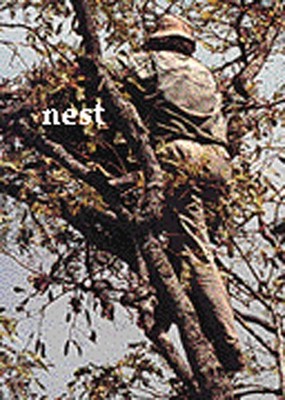
Anthropology professor Jim Moore sits, barefoot, in a cramped office overflowing with books and journals. But his mind is in the African savannah. When not wading through the piles of papers, he’s studying chimpanzees in Tanzania.
Moore is a member of the University of California, San Diego (UCSD) Project for Explaining the Origin of Humans. Scientists from UCSD and elsewhere participate in the project, a loose consortium of academics from a broad spectrum of disciplines. Anthropologists and archaeologists, molecular biologists and linguists meet to discuss the relevant science.
Moore uses chimpanzees, humankind’s closest living cousins, as a model for how early humans might have first left the forest for the savannah.
“Most of our ideas about hominid origins, and maybe human origins, have one key adaptation ” being the shift from forested area to a more open habitat,” Moore said.
Chimps, whose body size and diet are similar to that of early humans, remained mainly in the forest when hominids took to the plains, according to Moore. He and his students observe the few chimpanzees that inhabit the savannah today.
“I’m interested in how that changes the game for chimps,” said Moore, who hopes that by studying how chimps survive in the open environment, he can learn how early humans might have dealt with a similar setting.
A primate’s habitat influences its social network. In the forest, chimpanzees form groups of up to 120 individuals within a single, relatively small region. The males vigorously defend their territory, occasionally banding together to patrol the border and sometimes engaging in violent warfare.
In the savannah, the chimp population density is much lower. Thus, a large chimp troop has a much bigger territory. How do chimps interact when some of their buddies are miles away?
Moore wants to learn more about the savannah chimps’ social structure. Perhaps, he speculates, they use their long-range vocal calls to stay in touch. He also guesses that chimps may be less violent in the savannah, where they have fewer antagonistic neighbors.
With so few chimps in the savannah to study, Moore has more guesses than conclusions. When asked about his results, he merely throws his hands in the air, exclaiming, “I don’t know!”
Katerina Semendeferi, another professor of anthropology at UCSD and member of the Project for Explaining the Origin of Humans, is also interested in what apes can tell us about humans. She looks not to Africa, but inside the skull, for her answers.
“Where do human brains differ, and where are they alike, when compared to our closest relatives, the apes?” Semendeferi asked.
In the study of the brain, scientists have always made the logical assumption that bigger means better. Certainly, among primates, humans have the biggest brains. But which particular parts develop differently?
Semendeferi and her students, using brains donated following the natural deaths of humans and apes, aim to find out. They have analyzed specific brain regions to discover what makes humans think differently from other primates.
Brodmann area 10, which is where humans think abstractly and plan for the future, is particularly enlarged in human brains. This fits well with observed ape behavior ” so far as we know, chimps and gorillas don’t make a lot of “to-do” lists.
However, size is not always the key factor. When Semendeferi’s students examined other parts of the brain, something else stood out. Areas involved in speech and basic emotions were remarkable for their increased connections with other parts of the brain.
“In a way, we have the human brain talking more to itself than seems to be the case in other animals,” Semendeferi said.
These extra connections are a tiny part of what it means to be human.
While the origin of our kind remains no small mystery, UCSD scientists are deciphering the clues.
The Project for Explaining the Origin of Humans hosts occasional public seminars. For more information, visit origins.ucsd.edu.


