


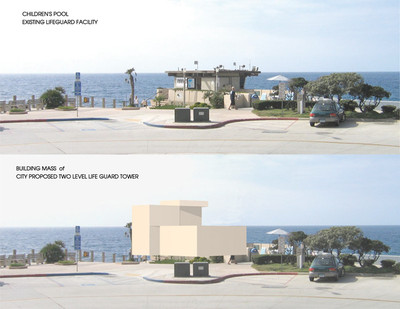
The City of San Diego is currently designing a new lifeguard facility and observation tower to replace the existing lifeguard facility that overlooks the Children’s Pool. According to city staff, the “client'” for the new facility is the City Lifeguard Service. I suggest the “client” also includes all San Diego taxpayers who will fund the project and the citizens of California who visit this unique site.
After Point La Jolla, the Children’s Pool Point may be the second most valuable public coastal bluff in all of La Jolla. According to some, the Children’s Pool, and its resident seal population, is the second most frequented tourist attraction in the entire city. This special site and the existing public plaza area deserve special consideration and protection.
The La Jolla community and the city recognized this when they included in the Coastal Commission-approved La Jolla Community Plan and local Coastal Program the requirement that views of the ocean from public roads be preserved and enhanced.
The city has made significant improvements to their proposed design for the Children’s Pool lifeguard station by locating the lifeguard locker rooms, laundry facilities and new public restroom facilities below the plaza level. The city’s proposed design places the primary observation platform at the second floor of a two-level tower.
However, the proposed two-story tower design still places two offices, a staff ready room with kitchen and a first aid station at the plaza / street level, resulting in a proposed building with a footprint nearly double the size of the entire existing facility, including the existing guard observation area that currently cantilevers beyond the existing plaza.
The city proposes a new two-story tower building that is significantly wider at plaza level than the existing lifeguard facility and would actually take away public views, instead of preserving or enhancing them.
The larger the new building’s footprint, the more the public plaza area is reduced, and a larger portion of the public’s ocean view is blocked. When viewed from the roadway, sidewalk and public plaza, the proposed building is 50 percent wider than the existing building and blocks 50 percent more of the public view of the ocean and horizon than the existing building blocks the view.
The city’s proposed design does not preserve public views. Instead, it will take away existing public views of the ocean and horizon.
While the city’s design would create a five-foot-wide plaza area between the building and the northern guardrail overlooking the Children’s Pool, this same plaza area will be “off limits” to the public when the tower is occupied in order to give the lifeguards “secondary observation” capability when working in their plaza-level offices.
One means of meeting the lifeguards’ space requirements and improving the functionality of the building, while preserving pubic views and public access to the plaza area, is to reduce the building footprint at the plaza level. This can be accomplished by arranging the required spaces into a three-level tower configuration. The plaza floor level could accommodate the ready room and first aid functions. The two office spaces could be located at the second floor level, and the primary observation platform placed at the third level.
The tower could be set back a full ten feet from the northern guardrail that overlooks the Children’s Pool.
I am not suggesting an architectural design for a three-level tower. Rather, I am suggesting an alternate conceptual spatial organization of the tower for the lifeguards’ and our community’s consideration.
A three-level tower concept has some real advantages:
1. The primary observation deck would be at a higher elevation, thereby significantly improving the lifeguards’ view up and down the coastline.
2. The supervisor’s office and adjacent work station at midlevel would be elevated above the plaza level and away from public distraction, and significantly improve secondary observation of the coastline in all directions without having to place a plaza level public viewing area “off limits” to the public.
3. The plaza-level ready room would allow views in three directions.
4. The building footprint of a three-level tower concept would be significantly narrower than that of the city’s proposed two-level tower design, and even narrower than the width of the existing facility.
5. The reduced plaza-level width of a three-level tower would preserve public views of the ocean and horizon from the plaza, sidewalk and roadway.
6. The three-level tower could be set further back from the north edge of the plaza.
i. This would vastly improve public circulation around the building.
ii. It would increase the usable area from which the public views the Children’s Pool.
7. As a narrower three-level tower would preserve the existing public views of the ocean and horizon from the public plaza, sidewalk and roadway; a three-level tower would conform to the requirements of the La Jolla Community Plan and local Coastal Program and the goals and requirements of the California Coastal Act and the Coastal Commission.
The La Jolla Community Planning Association (LJCPA) will consider the city’s proposed two-level tower design at its regular monthly on Thursday, Oct. 4, at 6 p.m. at the La Jolla Recreation Center, 615 Prospect St. All are welcome to attend to see a presentation by city staff and the project architect, and to ask questions and to voice their concerns. The LJCPA Trustees are expected to vote on the City’s proposal.
For the preservation of public views along our coastline, the preservation and enhancement of the public’s use of the Children’s Pool plaza viewing area and a much-improved primary and secondary lifeguard observation capability, a three-level lifeguard tower concept deserves further consideration by the lifeguards, city officials, the project architect, the LJCPA and our community.
” Philip A. Merten, AIA, architect, is a resident of La Jolla.


