


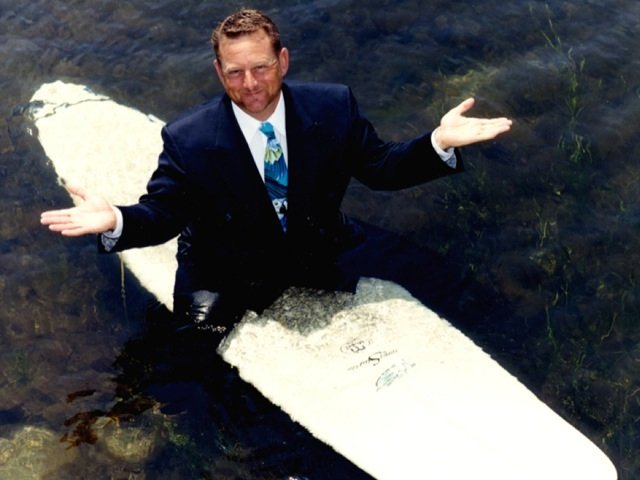
The Homeless Hero: a Novel, award-winning author Lee Silber’s 22nd book, is dedicated “to all those who have faced adversity and risen above it.” The nod may sound somewhat generic, but be assured that Silber, an inveterate surfer who set his book in the La Jolla area, knows of what he speaks. He spent a while off the waves in the body and soul of a homeless person as research for the story. His actual street time totaled less than a week, during which he got the flu and burned through the $40 he allowed himself; even so, he marvels at the very special stamina of those so circumstanced. “It’s a tough life,” he understated to La Jolla Village News, persuading the listener amid the charitable spirit behind his words. “I don’t think anyone appreciates it until you actually live it.” One of many federal reports says there are in fact more than 600,000 homeless Americans on a given night, a figure that might intrigue Silber amid what he calls a “factual fiction” approach to the book. None of those thousands was less likely a street prospect than former San Diego Charger Thomas “Big Mac” MacDonald, Silber’s central character. Divorce had rendered the onetime Bird Rock resident and ex-defensive lineman virtually penniless, stripped of everything but the classic VW camper he lives in. One thing leads to another, with Big Mac rebuilding his life (such as it was) – but the beach park at which he lives hides a mystery that would test the mettle of a man who stands on the doorstep of right versus wrong. Everybody, Silber said, will recognize a little of the local flavor, and without much prompting. North Mission Bay Drive’s De Anza Cove, recently reclaimed by the City of San Diego, is the makeshift Mariner Beach Park; the book’s ponytail-clad Jeffrey Weiner, advocate for the homeless, is in reality Jeffrey Sitcov, president of a Cardiff youth charity; editor Julie is based on Julie Main, dogged San Diego Community Newspaper Group publisher. There’s even a Mr. Frosty, counterpart to Pacific Beach’s Mr. Frostie on Garnet Avenue. Our area’s tonier enclaves color the story’s core irony – that homelessness can visit just about anyone. “Some are homeless by choice,” he said, “and have been for years. I don’t think you could talk them into any other way.” However, he countered in the book’s study guide, “[N]ot everyone who needs help is willing to ask for or accept it. I can relate. I realized I am like that. . . I didn’t realize that the person offering to help would get just as much out of it as I would.” So evolves MacDonald in this Deep Impact Publishing entry, which runs 263 pages – meanwhile, as it happens, MacDonald’s daughter Abby saves the day. Abby, 12, has had to grow up fast, in the shadow of a generation facing a world of uncertainties. “I really liked her,” Silber said, “and decided she was going to be my main character, in a way. She’s an advocate for the homeless, and I think there’s lots of millennials and teens making a difference in the world, and I wanted to highlight that.” The connection between Abby and Sitcov’s real-life homeless teen resource, he added, is a natural. So is Silber’s writing style, as the story’s easy cadence fuels this effortless read. There’s a good supply of humanity here from a man whose quiet passion bids the world take part. For more on Silber and the book, see leesilber.com. More information on Sitcov’s homeless teen charity is at photocharity.com. “The Homeless Hero” is available from amazon.com.


