



By Brook Larios | Slow Lane
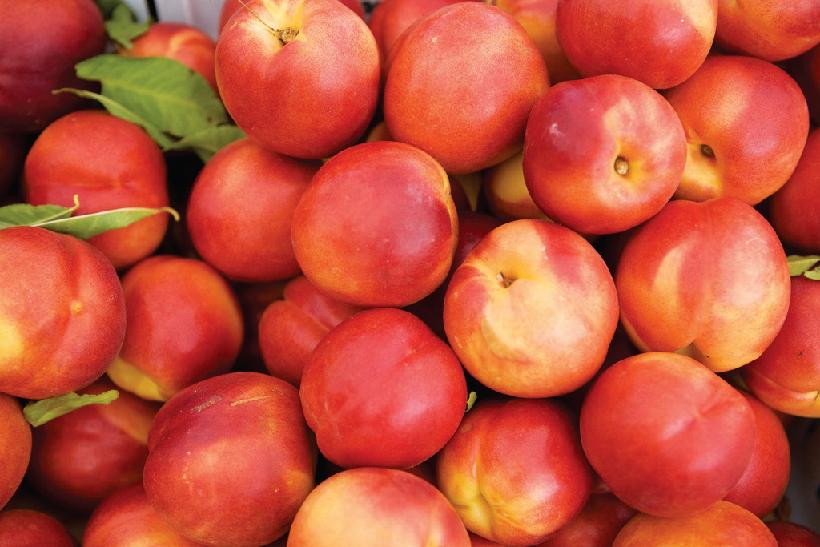
I was walking to a local farmers market one Sunday when I overhead a woman say to a man who appeared to be her significant other, “These peaches look lovely, but they’re not organic.” After briefly holding the naturally fuzzy fruit, she dropped it back into the basket that previously
cradled it, and walked away.
I turned as if readying for a duel, but instead of a gun, I drew words I hoped would inform her (after stalking her for several paces).
“I couldn’t help but hear your concern over the peaches back at that farm stand,” I began. “Did you know that many of our local growers practice organic farming techniques, but can’t or don’t want to invest the money or energy in earning the organic label? Better to buy non-organic fruit from a local grower who helms a small farm, rather than fruit from abroad that’s carried that organic label for thousands of miles. Here, at this farmers market, you have access to the people growing your food. Ask them how they grow it. Ask them whether they spray. Their produce is typically more organic than what you purchase in the supermarket with that pretty green label.”
Thankfully, the woman embraced her newfound curiosity and, without pause, we engaged in conversation — the type I wish everyone would have with our local growers, who sell their beautiful produce at nearly a dozen farmers markets in Uptown alone.
For something as, well, earthy and organic as organic produce, the steps to achieving organic certification from the United States Department of Agriculture (USDA) are laden with bureaucracy. In order to carry the coveted organic seal, a grower must not only have their soil, water and, sometimes, plant tissue tested (seems reasonable), but also submit a written annual production plan detailing nearly everything they do to inspire produce growth. Then there’s the annual inspector farm tour, examination of records and oral interview. (Isn’t farming fun?!) Oh, and they have to pay for that mandatory inspection — up to $2,000 per year. And they’re expected to keep an up-to-date log of each day’s farming and marketing activities on top of the already 15 or so daily hours they’ve devoted to growing good food for people they don’t even know. And you thought regularly balancing your checkbook was a pain!
Then there’s the level of organic—three total. Products created or grown only with certified organic ingredients and methods could be labeled “100% organic.” Likewise, those with at least 95 percent organic ingredients can legally sport that coveted organic seal. And here’s the kicker: products containing at least 70 percent organic ingredients can be labeled “made with organic ingredients.” Seventy. What a flimsy number. If a doctor dished you a 70 percent survival rate for cosmetic surgery, would you go through with it? Probably not.
Setting aside the latter, pseudo-organic group, let’s turn our attention to products that achieve the organic seal. How organic are they really? Depends. There’s a long list of synthetic substances that are allowed in organic farming and ranching (and, ironically, many non-synthetic ones that are not). For instance, according to federal regulations outlined on the U.S. Government Printing Office website, which shares official information from all three branches of the federal government, petroleum-based plastic mulch and covers are acceptable,
as are sucrose octanoate esters, aqueous potassium silicate (huh?), ferric phosphate used as slug and snail bait, and streptomycin and tetracycline (only through Oct. 21, 2012 on the mycin and cycline). Yes, those last two are, indeed, antibiotics and, by the way, a friend of mine is so allergic to the latter that she broke out in hives all over her body, even on her eyes and tongue, and had to have her skin scrubbed off and then grafted. You can bet your local growers are probably not using these substances. (Visit http://ecfr.gpoaccess.gov/ for the full list).
The next time you visit your local farmers market, whether in Mission Hills, Hillcrest, Kensington, Normal Heights or elsewhere, have a chat with your growers; they’re invaluable resources for making the right decisions for your family. And, unlike the USDA, which gives a pass to several items whose toxicity even the Environmental Protection Agency (EPA) is unsure of, they use the culmination of hundreds of years of knowledge to determine what’s edible. Knowledge is power—even more than the mega power structure designed to feed you.


