


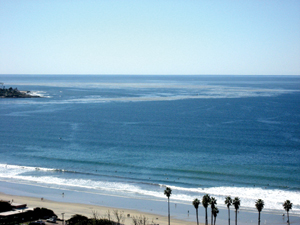
When I take a stroll along the Coast Walk bluffs overlooking the La Jolla Ecological Reserve or view the blue on a hike over Mount Soledad, I’m not scanning for wildlife but noticing the abstract designs on the sea’s surface. Smooth, oily-appearing streaks stand out against the otherwise textured, matte surface. Never noticed or heard anything about it? Aptly named the “sea-surface microlayer,” it is the thinnest and most nutrient-rich layer of the ocean — a slice half the thickness of the period at the end of this sentence, yet critically important to life in the ocean. Since 1917, when a Swedish researcher began studying the microscopic life that inhabits the vast territory that is the ocean’s surface, scientists have known that the surface microlayer teems with life. Over the decades, biologists have discovered scores of life, ranging from bacteria to plants and animals that live, reproduce or feed within this special habitat. Fish eggs are packed with fat globules (as are all egg yolks), which allow them to float in contact with the surface, making for a key nursery ground for many fish species. During their larval stage, many shellfish seek the surface where the microscopic crustaceans feed on even more minuscule life forms. Once the larvae reach a critical size, they migrate to deeper waters to search for larger foods, living out their lives on the ocean floor. Snails, some jellyfish and seaweed trap gas bubbles to float on the filmy layer. Seabirds may not have microscopes, but they know to capitalize on this floating feast by making their living skimming food from the surface. Although it may seem that the many fish and invertebrate eggs and larvae localized so close to the surface may as well be wearing neon signs that that say “Eat Me,” the sheer food abundance compensates for however much others pig out. The surface skin not only contains a super-dense concentration of microorganisms that stick to the undersurface but also harbors minerals and chemicals. Consequently, the biological properties here are wildly different from the waters below, and so are the physical goods. Nutrients brought to the surface from the natural upwelling of oceanbottom waters are concentrated and alter the surface’s optical properties by forming thin films where currents converge. While often invisible to the naked eye, it is at these junctures that they become visible as smooth slicks. Surprisingly stable, they hold together despite strong winds that whip up waves and whitecaps. In less than an hour after the water calms, the surface slicks reform. Unfortunately, the same physical stability that permits the microlayer to exist and support so much life also concentrates pollutants produced by human activities such as runoff, industrial wastes, trash and air pollution. Like nutmeg powder sprinkled on eggnog, pollution particles concentrate on the surface. Toxins in the microlayer are typically 100 to 10,000 times greater than in the water below. In the aftermath of an oil spill, the face of suffering and demise belongs to birds and marine mammals, but chronic contamination of the microlayer is far more menacing. Try visualizing oil spreading over the water’s surface at the same time fish are releasing their floating eggs, and it’s easy to imagine the devastating effects to not only that piscine population’s success but also other populations dependent on those eggs for food. Aside from tanker catastrophes, researchers have discovered in the waters off our coast (and other watery parts of the planet) a sadly consistent picture: The surface microlayer is becoming a soup of toxic metals, organic pollutants, pesticide resides and petroleum-based particles (from plastic bags, water bottles and the like). Larvae lucky enough to hatch in these tainted microlayers may emerge deformed, develop more slowly or die. Taking a big-picture view, the sea surface microlayer forms the foundation of a far-reaching food chain. It’s like the coveted layer of cream floating on the surface of unpasteurized milk. Everybody wants some of it. Seabirds and other critters descend on the layer from above, while many marine creatures ascend to it from the deep. Consequently, when the surface microlayer is polluted, it can potentially poison much of the food web, from infinitesimally small life to fish to whales and to us. In one example, male fish living in water contaminated with chemicals that mimic sex hormones were found to have their reproductive development disrupted. Effects to humans from consuming such fish are presently unclear, but these and other hormonelike chemicals are considered likely carcinogens. It is easy to ignore what we can’t see, but we do so at our peril. Studying the sea’s remarkable skin has enlightened us about this unexpectedly rich area and confirmed more about the worldwide breadth of our poisoning of the world’s ocean. The ocean’s surface microlayer habitat is becoming endangered not unlike the melting homeland of the polar bears. There’s no furry face to plead for saving the ocean’s skin, though its loss may affect many more life forms. Because the surface microlayer cannot be contained to one part of the world’s ocean, its plight emphasizes the need for long-range, international ocean conservation instead of our present mode of short-term, localized crisis management. — Judith Lea Garfield, biologist and underwater photographer, has authored two natural history books about the underwater park off La Jolla Cove and La Jolla Shores. www.judith.garfield.org. Questions, comments or suggestions? E-mail [email protected].


