


Uptown adult care center gets a holiday handout
Morgan M. Hurley | SDUN Assistant Editor
The Glenner Memory Care Centers have been mainstays in the Uptown area for more than 30 years, but this past holiday season they got a boost from a local group of guys who love to pay it forward.
The San Diego Gay Men’s Chorus (SDGMC) chose Glenner as its 2013 beneficiary for their annual “Nutcracker: Men in Tights!” holiday show, which took place at the Balboa Theatre on Dec. 14 and 15.

Early in each performance, attendees were given a short
presentation followed by a testimonial about the local nonprofit, which came from their outgoing artistic director Gary Holt. They were then were asked to participate by dropping donations for Glenner into the “Big Ruby Slipper” in the lobby during intermission.
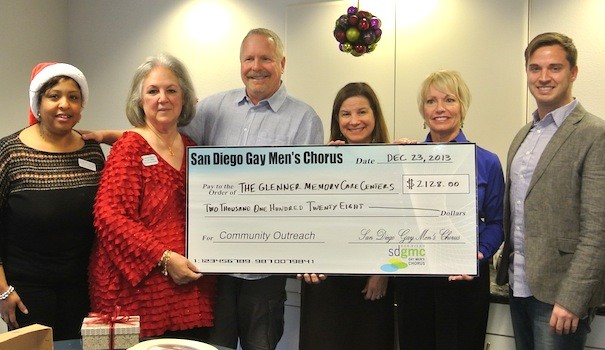
A couple of weeks later, members of the SDGMC presented Glenner Memory Care Centers with a check for $2,128, which was raised during the two performances. Aside from the financial help, the chorus members themselves had also brought a cache of other useful arts and crafts items for use at their adult day care program.
Kevin Hannahoe, a member of the SDGMC and a special events volunteer at Glenner, first proposed the nonprofit to be the annual beneficiary, but Glenner’s ties to the SDGMC were deeper than they initially realized and after they were approved. It became known that Holt’s father had received care at Glenner for several years back in the 1990s.
Opened in 1982, the facility was originally named the George G. Glenner Alzheimer Family Care Center, after its founder, a research pathologist who specialized in the disease. At the time, it was one of the first centers in the nation focused on people with dementia. Since then the name has been shortened to more accurately reflect the individuals it provides services to.
Today, it still stands as one of the few places where adults with dementia can have quality, engaging day care with a structured program of art, crafts, dance and other exercises, and also offers families an abundance of support and resources, too.
“Dementia is blanket term for a host of brain disorders,” said Anne Saita, Glenner’s marketing and developmental manager. “Alzheimer’s is one form of dementia and most common form. In the public vernacular, they are treated the same. Back in the day it was called ‘senile’ and that word has gone away.”
Glenner is run by CEO Anette Asher, a small administrative staff at their corporate offices in Hillcrest, an 18-strong board of directors, and a 33-member advisory council made up of medical professionals. In addition, its three adult day care centers — Hillcrest, Chula Vista and Encinitas — each have their own program director, staff and a host of interns and volunteers. There is a one-to-five patient-to-staff ratio, which ensures each participant gets the one-on-one support they need.
Saita said current research shows that at age 65, you have a one-in-eight chance to develop dementia. That number goes to one in two by age 85, and at 95, she said everyone basically has it but you may outlive any developing symptoms.
“Adult day care in general is not very well known,” Saita said. “People think they need to pay for in home care or put them in a residential facility — this is an in between step that can help alleviate issues, challenges, and stress associated with the disease while improving quality of life for everyone in the household.”

“They are only here for the day,” Asher said. “They go home every night and they live at home. These generations, they want to live and die in their own home.”
As an affordable alternative to live-in facilities where family interaction is often limited, Glenner offers the adult with dementia a safe place to socialize and keep active during the day, while giving the caretaker a guilt-free and necessary respite from 24-hour care.
In Hillcrest, the care facility is known as “the little blue house,” and Glenner staff says it looks like a house both inside and out for a reason: to eliminate the “institutional” appearance and to make it feel like their second home.
“At some point if your parents live long enough the roles reverse and the child takes care of the parent, very much the same way the parent once took care of the child; changing diapers, making sure that they eat, fighting with them to eat, making sure they don’t watch too much TV, making sure they go to bed on time, and that they stay in bed,” Satia said.
Board member Dawn Egan got fully engaged with the organization after seeing the impact the center had on her father, whom she took care of for 17 years. Through her involvement on the board, she now acts as a personal experience ambassador, sharing her dad’s story as well as her own.
“Having Dad attend the Glenner actually gave him more life,” Egan said. “He was in that mode of sitting in front of the TV and he wouldn’t do anything else, no matter what I suggested.”
Egan said Glenner also helped her father find a love for drawing, something no one in the family had ever seen him participate in.
“He passed [early last] year and now I have a stack of sketchbooks that he began in January of 2008,” she said. “While it was a battle from time to time to get him here, once he got here he became engaged and it actually stimulated his mind quite a bit,” she said.
Glenner staff all emphasize that mental stimulation is very important for patients with Alzheimer’s.
“There was a huge digression of [my dad’s] disease and it brought him back around for a while,” Egan said. “It also kept him knowing who we were and he maintained that until the end and that is astounding.”
Egan also explained how the interaction and socialization her father received at Glenner actually helped him become more interactive with his own family and grandchildren, and he began looking forward to their visits rather than isolating himself once they arrived.
Weekly family support groups are offered for free at Glenner, with free adult day care for their loved one also available during the one and a half hour session so that caregivers don’t have to be separated from their loved ones. These support groups not only give the family and caregiver a place to release and share their stories, they will learn more about the disease and receive tools for enhancing care.
“You have to learn how to step into their world,” Egan said. “You can’t fix them, you can’t change this, and you have to figure out how to make it easy not only for them, but yourself. I will never forget this place and Marge Galante [Hilcrest program director] was a god send.”
“What we do in our Centers, we live in their reality, we don’t make them wrong,” Asher said. “We don’t say ‘don’t you remember?’ or ‘you forgot again?’ It’s none of that. Whatever they are thinking and feeling or whatever they are want to be we work with it.”
Asher said Glenner used to have an annual gala, but changed their fundraising methods in 2013 to free up staff and funds and to focus on ways to engage the participants and their families in the fundraising process. In 2014 they hope to hold a number of events throughout the year that will be open to the general public.
For more information or to donate, visit glenner.org.


