


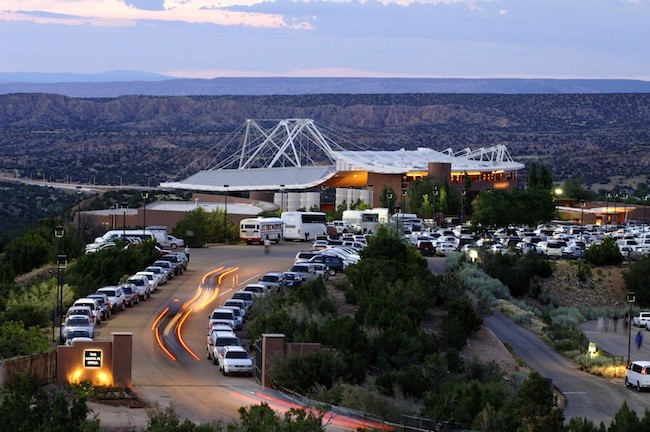
Local opera-lover spends time at one of the nation’s leading opera companies; returns to regale readers
By Charlene Baldridge | SDUN Theater Critic

Summer vacation for me was spent in Santa Fe, New Mexico taking in operatic wonders, especially as they pertain to rarities, gods and demigods, both human and otherwise.
Unusual and daring programming has drawn dyed-in-the-wool opera-philes every year since the Santa Fe Opera’s 1957 founding by John Crosby, who devoted much programming in the early years to performance of Richard Strauss’s works. The company is dedicated to producing new, standard and unusual fare. More than half the annual audience of 85,000 comes from outside New Mexico, from every state in the U.S. as well as 25 to 30 foreign countries.
During our week in Santa Fe, writers from The Wall Street Journal, Chicago Tribune and Associated Press were in attendance, and the chief music critic of The New York Times attended the previous week. It is only in August that the entire festival repertoire may be seen during one week.
What impressed me most about my time visiting the Santa Fe Opera is the quality of the young master-class singers, drawn from the organization’s apprentice program. Four – all mezzo-sopranos – worked with acclaimed opera star Susan Graham. After taking her vocal and dramatic comments, each improved, as if by magic. One, who sang from Gluck’s “Orpheus and Euridice,” left me drowned in my own tears.
The 43 apprentices, who sing supporting roles and provide Santa Fe Opera’s expressive and wondrous chorus, are all American singers. In fact, the majority of the 16 principals in Santa Fe are from the United States as well, many from the Midwest, with healthy, robust voices and beautiful, buff bodies.

The opera master class was not open to the general public – my friend and I were invited as critics – but Graham and some of the apprentices presented a recital several days before our arrival, an event that is quite popular with Santa Fe Opera goers.
For the season, there were a lot of gods with which to contend. My favorite production and biggest puzzlement was the rare and exceptional “King Roger,” a brief piece by Polish composer Karol Szymanowski. Based on Euripides’s “Bacchae,” the libretto concerns a Shepherd (tenor William Burden) who upsets a king (Polish baritone Mariusz Kwiecien), the established belief system and his entire kingdom. The shepherd is Dionysus in disguise. Open to many interpretations, the opera is described by many as the tale of a gay man, married to a woman and trying to find a way out of the closet. The U.S. director Stephen Wadsworth staged it.
Other rarities and favorites were Richard Strauss’s “Arabella,” which will continue through Aug. 23, and Gioachino Rossini’s “Maometto II.” Also known as “The Siege of Corinth,” this opera was the vehicle for Beverly Sills’s acclaimed Metropolitan Opera debut in 1975. In Santa Fe, the Sills role was sung by soprano Leah Crocetto with Patricia Bardon in the pants role of Calbo. The title role was sung by Venezuelan bass-baritone Luca Pisaroni, who gave a bravura reading of the highly ornamented role, proving there is such a thing as a coloratura bass-baritone.
The season’s remaining works are all sure-fire, semi-standard and standard repertoire: Georges Bizet’s “The Pearl Fishers,” which plays through Aug. 26, and Puccini’s “Tosca,” with famed American baritone Thomas Hampson as Scarpia, concluding Aug. 24.
We also encountered friends and professional administrators from around the country this season, and even befriended a Polish maestro who follows his countrymen Mariusz Kwiecien and coloratura contralto Ewa Podle? all over the world. We’ll see him again next January when Podle? sings with San Diego Opera.
The guys are hunks, and the divas are reigning queens of operatic stages worldwide. Judge for yourself, either by making a quick trip to Santa Fe before the end of the month, or making plans now for the 2013 Festival season. For more information visit santafeopera.org or call 505-986-5955.


