


By Katherine Hon
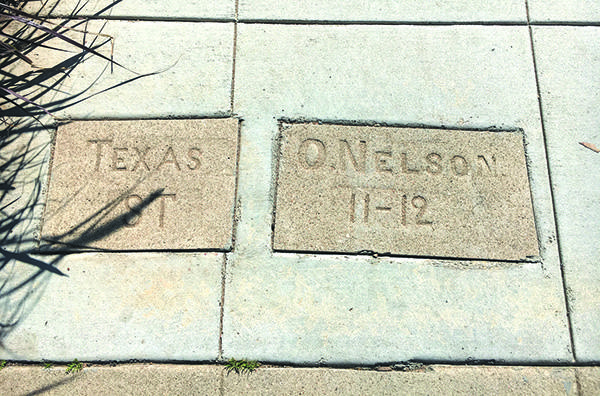
O. Nelson, John Engebretsen, F. Anderson — do these names look familiar? Do you get the sense you have seen them in writing but can’t place where? They are just a few of the many names of contractors who installed the sidewalks in San Diego in the early 1900s through the 1920s.
The University Heights Historical Society (UHHS) has estimated that the first concrete sidewalks in San Diego were laid during the 1880s, and contractors began embedding their names or company logos in them by the 1890s. The names and dates set in concrete help tell the story of San Diego’s development.
In 2013, to celebrate the 125th year of University Heights, UHHS volunteer Bill Ellig compiled an online map with photos of more than 350 historic contractor sidewalk stamps, some as early as 1910. (View the interactive map at uhcdc.org/contractorStamps.html.)
Enthusiastic fans of Ken Kramer’s KPBS television show “About San Diego” have posted photos of sidewalk stamps around the county on the show’s Facebook page. Joseph Kelley — who engraved “Contractor in Cement, Office 964 Fifth Street” below his name within his oval stamp — laid and marked some of the earliest sidewalks in Downtown. He is listed as a contractor in the 1893 San Diego City Directory. A photo of his 1906 stamp at Second Avenue and Maple Street, taken by John Pagenkopp, is posted online.

The stamp “O. Nelson” appears frequently with various dates on North Park sidewalks south of University Avenue, including Texas Street (1912), Spruce Street (1916) and Dwight Street (1924). This is the stamp for Olaf Nelson, who was born in Sweden in 1858 and came to the U.S. in 1883, when he was 25 years old. He became a naturalized U.S. citizen in 1892. The 1904 San Diego City Directory listed him as part of “Engebretsen & Nelson, contractors for paving, grading and all kinds of cement work, concrete construction, stone and brick work, 614 5th rms 5 and 6.” However, this partnership did not last — the following year the two had independent advertisements in the directory.
Nelson installed sidewalks in various parts of the city, including along National Avenue, Falcon Street and Grand Avenue, sometimes beating his former partner John Engebretsen for the successful bid. He also graded many roads, including Park Boulevard, Thorn Street and Pennsylvania Avenue. He even installed some fire hydrants in La Jolla. Nelson lived with his wife Carrie on E Street from 1905 until he died in 1937. They had two sons, Chester and Carl.
John Engebretsen was born in Norway in 1858 and came to the U.S. in 1882, when he was 24 years old. He became a naturalized U.S. citizen in 1888. Although his name is not spelled correctly, he is likely listed in the 1897 San Diego City Directory as “John Engebret, contractor.” One of his stamps from 1923 is in the sidewalk at the southeast corner of Lincoln Avenue and Utah Street. He built roads in Coronado on North Island, as well as in Point Loma.

Engebretsen and his wife Julianna lived at 641 12th Ave. from 1914 until his death in 1935. In addition to his job as a grading contractor, he served as the vice consul for Sweden and Norway starting in 1896; he later became dean of the consular corps. The King of Norway made him a Knight of St. Olav in recognition of his long and excellent diplomatic work.
The stamp “F. Anderson” belongs to Frederick Anderson, who was born in Denmark in 1861. He came to the U.S. in 1881 at age 20 and became a naturalized U.S. citizen in 1891. He appeared in the 1903 San Diego City Directory as a cement worker for J.P. Christensen, who was the proprietor of Pioneer Artificial Stone Works. In the 1904 San Diego City Directory and later, Anderson was listed as a cement worker on his own. He and his wife Henrietta had two daughters, Charlotte and Josephine.

F. Anderson sidewalk stamps, with dates ranging from 1913 to 1915, appear along Pershing Avenue south of University Avenue and north of Upas Street. Interestingly, one stamp reflects an interesting typo. The date engraved in the sidewalk on the east side of Pershing Avenue between Myrtle Avenue and Upas Street is 1903. This is wrong, not only because development in this part of North Park did not begin that early, but also because Anderson was working for J.P. Christensen at this time. The date likely should have been 1913.
[Editor’s note: Future PastMatters columns will feature more stories at our feet on Uptown streets.]
—Katherine Hon is the secretary of the North Park Historical Society. Reach her at [email protected] or 619-294-8990.


