


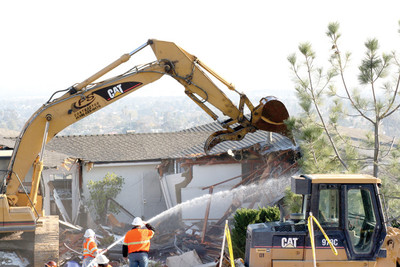
Tom Crabbe, one of the most vocal of the Mount Soledad residents before the Oct. 3 landslide, was a man of few words as he watched his home being demolished by a city work crew Friday, Dec. 14.
“Today is very hard,” Crabbe said. “But every day has been hard.”
Crabbe’s home was one of three slated for demolition, although only two were torn down Friday on Mount Soledad Road, as the third was too toxic, said Patti Boekamp, director of Engineering and Capital Projects for the City of San Diego. The third home was razed later in the week after being cleared of asbestos and other toxins.
Crabbe sat across from the homes on a neighbor’s driveway, videotaping and watching as both his and the neighbors’ homes were demolished by an excavating bulldozer.
Beginning in July, Crabbe made numerous phone calls to high-ranking city officials about the constant leaks on Mount Soledad Road. In a recently released interim report by City Attorney Michael Aguirre, Crabbe called Water Department Director Jim Barrett but could not get in touch with him.
According to an interoffice e-mail between Barrett and his executive secretary, Crabbe and his neighbors were “very concerned because something [was] going on in the area. The street…appears to have dropped 3 inches…They feel the ground may be shifting which may have caused the break last night.”
“Barrett did not call Crabbe back immediately,” Aguirre wrote in the report. “Rather, Barrett forwarded the e-mail to other high-ranking City officials on 19 July 2007, and requested a conference to discuss the water breaks and how the City would respond to Mr. Crabbe.”
After many months of documented water and sewer leaks and Crabbe calling officials to report them, the land finally slid Oct. 3.
And the city may charge the homeowners for demolishing their homes, Boekamp said. But they are deferring that decision until a later date.
While homeowners continue their investigation into the cause of the landslide and their lawsuit against the city, construction of the street and stabilization of the hill moves forward.
All homeowners must rely on the excavation process, which currently includes investigating water pipes taken out of the ground then reassembling them at a storage facility in Rose Canyon. The next step will be to examine the sewer system.
Meanwhile, construction crews continue to stabilize the slope, a process called winterization, said Carol Drummond, public information officer for the city of San Diego.
Construction crews have completed Phase I of the process, which consisted of installing shear pins into the side of the landslide. Options for Phase II are currently being considered.
“Options are up in the air right now,” Drummond said. “There are several different options for stabilizing the slope and pulling the road back, which may include shear pins or comparable measures.”
Winterization of the slope will include removing 20,000 cubic yards of dirt, then regrading the slope, in addition to installing drains and ditches, Drummond said.
And with rain and storms predicted, officials will continue to use their rain contingency plan until the winterization is complete, Drummond said.


