


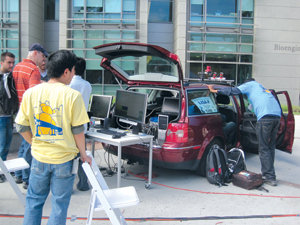
Cars that can talk, think, detect obstacles and brain activity and even drive themselves provided a glimpse of the future at a June 24 exposition at The University of California, San Diego’s (UCSD) Warren Mall as engineers and automobile manufacturers presented vehicles with innovative, autonomous features as part of a research challenge. “Lots of accidents could be prevented with driver-assistance systems,” said Ganymed Stanek, a systems engineer at Stanford University who previously worked for Volkswagen as an intern. “People falling asleep, swerving into other lanes, or getting distracted and not slowing down fast enough can all be avoided with features produced by this technology.” While Stanek said fully autonomous cars are still in the more distant future, many important features are currently being integrated into high-end vehicles. “Top-of-the-line cars today have lane-departure warnings, sensors for blind spots and automatic brake features when a crash is imminent,” he said. “Just to name a few.” Stanek said 40,000 people die in car accidents each year in the United States. “This technology has the potential to save a lot of lives,” Stanek said. Children under age 16, as well as the disabled and elderly people who are no longer able to drive will also enjoy new freedoms, Stanek added. “These developments have the potential to give those demographics a lot of increased mobility,” he said. At the exposition, Stanek demonstrated a 2006 Volkswagen Passat that was programmed to park itself when dropped off at a parking structure, which he compared to a valet service. “Many cars, especially in Germany, already a have a self-parallel-parking feature,” Stanek said. “This is different because the driver can get out at the entrance of a structure and press a button, then the car will use a map of the structure to follow a path and detect whether a spot is free using sensors, then park and shut itself off. At the end of the night, the driver can use an iPhone application to retrieve the car.” Volkswagen and Stanford teamed up for Urban Challenge 2007, a call by the Defense Advanced Research Projects Agency (DARPA) to program cars that could travel 60 miles without a driver in an urban environment. “We tried to come up with a sub-part of driving and settled on a valet-park function,” Stanek said. “What we’ve developed is fully functional, but there are lots of iterations to go through before it’s ready for consumers. It will be available at some point, but not in this form.” The exposition followed a four-day Institute of Electrical and Electronics Engineers (IEEE) Intelligent Vehicles Symposium at UCSD, which marked the international event’s first appearance in California. At the event, the Intelligent Transportation Systems Society released a study in its quarterly academic journal recognizing UCSD researchers as world leaders for new publications in intelligent transportation. In addition, the society ranked UCSD among the three most influential research institutions in the field.


