


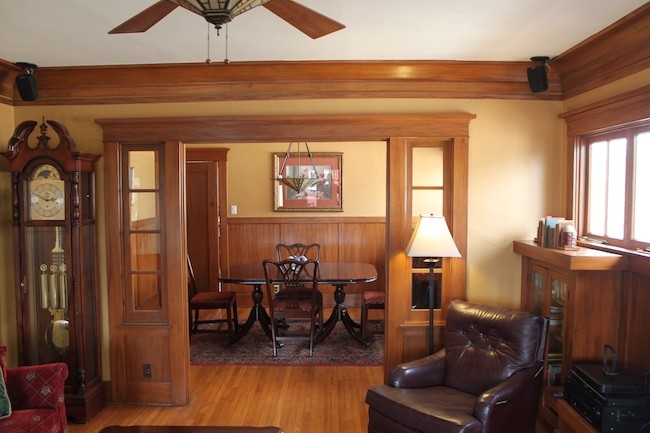
The modest bungalow is often overlooked by historic house hunters
By Michael Good | HouseCalls
It’s a familiar refrain, repeated by house hunters as they scour the former streetcar suburbs of San Diego: All the good houses are gone! The classic Craftsman. The spectacular Spanish. The completely intact, perfectly preserved Arts and Crafts masterpiece. Snapped up! Off the market!
And don’t even get them started on the flippers.
There are a lot of gutted, flipped, bowdlerized houses available. But there are also a lot of amazing, well-preserved vintage houses on the market. I know because readers of this column show them to me pretty regularly, seeking my (as-long-as-it’s-free) advice.
So where are these glass-half-empty people going wrong?
For starters, they’re looking in the wrong place — exclusive neighborhoods, rather than quirky, transitional areas. And when they do look in the right place, they don’t see what they’re looking at. They get distracted by the grit and the grime, the gloppy paint and the mutilated millwork, and they miss the diamond in the rough. All they see is the rough.
That certainly wasn’t the case with Ron Benefiel, a minister-turned-college-dean who has owned a few old houses in his day and knew a jewel when he saw one. Benefiel’s ministry was to the poor and disenfranchised; the houses he lived in had experienced their own bumps and bruises. When asked to describe his former residences, he says, in his concise way, “In downtown Los Angeles, a 1908 Craftsman two-story. In Kansas City, a 1912 Georgian Colonial.” Then he adds with a fond smile, “Grand old lady.”
In spring 2014, when he was house hunting in North Park, Benefiel was looking for something a little less grand than his former Georgian Colonial. His wife had recently passed away. And the kids had moved out and bought houses of their own in nearby Webster and Stockton. There wasn’t a lot on the market, but fortunately, he’d employed a network of scouts.
“One of the philosophy professors, who works just down the hall from me, was driving by on the day the seller’s agent was showing the house to other real estate agents. She stopped in, had a look around and called me.”
Benefiel grabbed another professor for backup, and drove up the hill from Point Loma Nazarene to Redwood Street. “I looked at it and said, ‘I think this is it.’ And I put in a bid and bought it. It happened fast. I really lucked into it.”

He also lucked into a real estate agent who was experienced with old houses — Ron Rooney of Ascent Real Estate, who happens to live around the corner in an historic Spanish Revival house across from Bird Park. Rooney felt obliged to point out where the place needed some attention, such as the mangled paneling in the dining room.
“Obviously there was some damage to the wood,” Benefiel said. “Ron Rooney pointed that out. He said, ‘You’re probably going to need to do some work here. Call Michael Good, he’s the wood guru.’”
That’s where I entered the picture. After stripping the white paint from where it had been ground into the panels’ wood grain, Benefiel and I turned our attention to the question of stain color, typically a 15-week, nervous-breakdown-inducing experience, involving medical professionals, yoga instructors and life coaches. Benefiel is accustomed to making quick decisions of great spiritual import, so it took about a minute and a half. Here’s my recollection of the conversation, presented in the form of a (very) short play.
(Stage directions: Two men stand face-to-face in a barren room festooned with blue tape and green masking paper. Late afternoon light streams in through the room’s many windows. Classic ‘50s jazz plays in the background. The two men look around, admiring the freshly stripped wood.)
Ron: It kind of reminds me of a men’s club.
Michael: Well, you are a man. Men like wood.
Ron: Exactly.
Michael: Deal with it, people. (Laughs.)
Ron: (Laughs.)
Michael: (Pause.) There is a lot of wood in here, Ron. It needs … presence.”
Ron: Don’t want to go too light.
Michael: Don’t want to go too dark. Nice rich, medium brown. With a little red in it. After all, it’s red gum.” (He holds up a small piece of stained wood. They both examine it in silence.)
Ron: Looks good. I like it. Let’s do it. (End of scene.)

Having selected the stain, we next turned to the question of wall color. When choosing colors, it’s sometimes helpful to limit the possibilities, stand on the shoulders of giants, so to speak. So I took out my putty knife, shaved off some layers of paint and plaster, and brought the two oldest chips — a deep brown and a rich caramel — to Sherwin Williams on Morena Boulevard, where they did a computer color match. I painted the two sample colors they provided on a couple of sheets of two-by-two drywall and held them up for Benefiel’s appraisal.
His reaction was immediate. “I like the yellow-colored one, “ he said. “Not the brown.” Both samples were fairly deep colors, saturated, unlike the usual pastels you find today. The brown was most likely the original, but Benefiel wasn’t so sure.
“It’s interesting,” he said later of the C.S.I.-like process. “I probably would not have gotten those colors. I think it just came out beautifully. Which makes me wonder.” He is back in his completed living room now, looking at the wall. “And this is what? The second color? Maybe someone made an adjustment, and they went to this color.”

“Could be,” I said. “People changed their minds during the construction process. It happened all the time.”
If someone did change their mind, if someone had painted the walls brown and then thought better of it, that person would likely have been the house’s first owner, Mary F. Gooch. She was born Mary McCarthy in Ireland in 1865. At age 12, she immigrated to the U.S. In 1890, she married Edward F. Gooch in Lawrence, Massachusetts. Edward had been working since age 15, when he took a job sweeping up at the local dye factory. Twenty years later, he was running the place — the Brooks Dye Works, one of the largest fabric dyers in the country. The building spanned several blocks, in a dense residential area of Bristol, Massachusetts.
Edward and Mary and their daughters moved to San Diego County in 1900, presumably for Edward’s health (he had pulmonary tuberculosis; one “cure” was dry, fresh air). Former city dwellers, the Gooches were part of the “back to the land” movement. They purchased property over the next few years in the Descanso area. Edward served on the school board in Descanso, but in 1906, he succumbed to his illness. Mary continued to manage the ranch, and added to her property holdings in San Diego, where she resided with her four daughters, who all attended Academy of Our Lady of Peace.
Mary and her daughters moved frequently. Before occupying the newly constructed house on Redwood, in 1922, Mary and her daughters lived around the corner at 3144 Granada; they also lived in South Park, at 1503 29th St. In 1924 Mary’s youngest daughter, Agnes, got her teaching credential and went to work at the one-room schoolhouse in Dulzura. Mary moved back to Descanso, and sold the house on Redwood Street to another rancher, John R. King, and his wife, Mary Eunice. King was a gentleman farmer, splitting his time between his ranch in Missouri, managed by his son, and his home in San Diego. He and Eunice moved out of the house on Redwood in 1927, to another small house on Wilson Avenue.
Mary Gooch died in 1929, and like her husband Edward, was buried in Calvary Cemetery, the old Catholic cemetery next door to Grant Elementary School in Mission Hills. The cemetery fell into disrepair in the 1940s, and in 1970 the headstones were removed (but not the bodies). The cemetery is now a park.
While their stories tell us something about the people that lived in the neighborhood in the ’20s (who would have thought they were ranchers?), there’s nothing in the public record to indicate whether Mary or John or Eunice were partial to brown or yellow, or why Mary didn’t stay in the little two bedroom house on Redwood Street, which seems so perfect for a person of faith who has lost a spouse and whose children have moved out. This is the sort of subject Benefiel likes to ponder while basking in the warm glow of his woodwork and walls.
“What happened in this neighborhood back in the day?” he asks. “Who were these people? Why were they building homes like this? Why all this attention to woodwork? To me, the opportunity to restore — and not just modernize — is part of what it means to live in a house like this.”
Benefiel said “the value” is what originally attracted him to the house. “I’ve always valued older homes. Charm. Architecture. History. Culture. I’m a sociologist. There’s a sense of place in history. It’s a deep well to drink from.”
And now that he’s lived there for a while, and finally got the walls the right color?
“Um, you know, there’s a certain … I don’t want to go too far off the edge, here, but you know how we have a lot to learn from Native Americans and their respect for the land? We need to have a certain respect for the people who lived in a home before us. They lived here in the neighborhood, raised their kids here, died here. It’s more than just a place to hang my hat. It’s sort of the spirit of the place and a sense of respect for everything that’s gone before that’s symbolized in the house. There’s some value in that.”
—Contact Michael Good at [email protected].


