


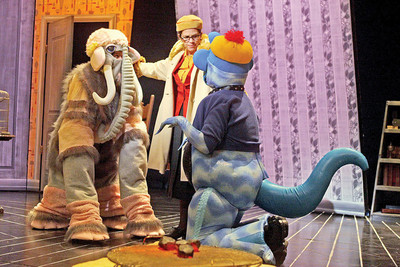
It’s time for a pair of classics ” one ancient, one 20th century ” at University of California, San Diego (UCSD). The department of theater and dance presents Thornton Wilder’s ever-timely “The Skin of Our Teeth” through Saturday, Dec. 1 in the Sheila and Hughes Potiker Theatre, and a short run, through Saturday, Dec. 1 only, of Euripides’ “Medea” in the Mandell Weiss Forum. Deadlines preclude a review of the latter, but insiders confide it is not to be missed.
It’s a rare treat to revisit “The Skin of Our Teeth,” Wilder’s prescient, 1943 Pulitzer Prize-winning rumination on the durability of humankind as represented by the Antrobus family. The university benefits as well, because the play, directed in this production by third-year MFA candidate Sarah Rasmussen, requires many actors, who play prehistoric creatures, the poet Homer (Josh Wade), Moses (Brandon Taylor), a fortune teller (Lorene Chesley), and Muses (Molly Fite and Pearl Rhein) as well as a put-upon stage manager (Larry Harron) and backstage crew. Kristin Ellert creates the settings for disaster, Stephen Sakowski, the lighting, and Christopher M. Luessmann, the sound.
In Act I the Antrobus maid, Sabina (fetching Rebecca Levy), awaits the return of Mr. Antrobus (Joel Gelman) and worries that he’s not yet returned after a busy day inventing the wheel and the multiplication tables. Outside the home in Excelsior, N.Y., a sheet of ice threatens (uproariously, a large ice cube in the projections). It’s so cold, in fact, that Mrs. Antrobus (Michelle Diaz) brings in the family pets, a woolly mammoth (Christine Herde) and dinosaur (Matthew Bovee), fancifully designed by Rachel Shachar.
Sabina, whose name stands for the Sabine Women (she was raped from her home by Mr. Antrobus), complains about the script and the play throughout. Indeed, the play was, and is, a stretch in time and good sense that teases the mind with the possible meaning of three disasters, an ice age, a flood and a devastating war. Wise money seems to believe Wilder was addressing the inventiveness and resiliency of the human species. In these frightening times, one hopes that he is right.
There were three Antrobus children until that rascal Henry (Rufio Lerma) killed his brother Cain, occasioning his name change. Gladys (Liz Elkins) is the Good Daughter, though somewhere between the chaos of Act II and the devastation of Act III she managed to get preggers and deliver a child, something that everyone considers unremarkable.
Near the end of Act III, having returned from the war (in which it is remarked that Henry was the enemy), the core metaphor of the work is uttered: “Oh, I’ve never forgotten for long at a time that living is struggle. I know that every good and excellent thing in the world stands moment by moment on the razor edge of danger and must be fought for ” whether it’s a field, or a home, or a country.”
Amen and thanks.
“The Skin of Our Teeth” continues at 8 p.m. tonight (Nov. 29) and Friday and 2 and 8 p.m. Saturday at the Potiker Theatre, UCSD, 2901 La Jolla Village Drive.
“Medea” plays at 8 p.m. tonight through Saturday in the Mandell Weiss Forum Theatre (don’t think of going without a reservation), http://theatre.ucsd.edu.


