


A new “wrinkle” has developed in the contentious debate over SeaWorld’s plan to nearly double the size of its killer whale enclosure: the California Coastal Commission approved the expansion, but attached conditions that the theme park has deemed unacceptable.
Coastal Commission staff recommended the project be approved with the stipulation that SeaWorld cannot populate the pools with orcas caught in the wild, nor use genetic material from wild orcas to breed killer whales in captivity.
That decision led to SeaWorld’s subsequent announcement Oct. 15 that the company intends to pursue legal action against the California Coastal Commission (CCC) for “its overreaching condition that would ban killer-whale breeding at SeaWorld San Diego.”
“Animal welfare is governed by federal and state laws that do not fall within the jurisdiction of the California Coastal Commission’s appointed board,” said Joel Manby, president and CEO of SeaWorld Parks and Entertainment. “As a regulatory board charged with managing coastal development and related land-use decisions, the Coastal Commission went way beyond its jurisdiction and authority when it banned breeding by killer whales at SeaWorld. By imposing broad new jurisdiction over all future SeaWorld marine animal projects, as well as aquarium projects elsewhere in the state, the commission has overstepped both federal and California law.”
“It simply defies common sense that a straightforward land-use permit approval would turn into a ban on animal husbandry practices – an area in which the commissioners have no education, training or expertise,” added Manby. “To say that this is a dubious decision with no legal basis is an understatement, which is why we must and will challenge the commission’s decision.”
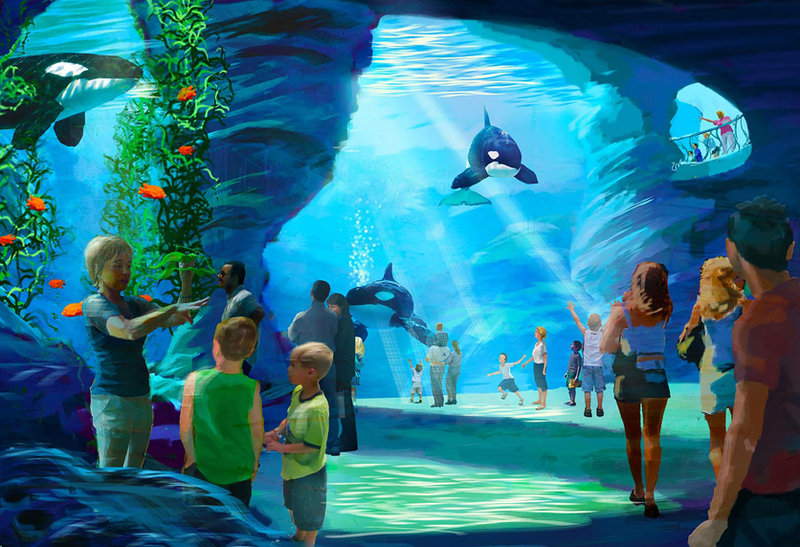
SeaWorld plans to nearly double its orca enclosure from 5.8 million gallons to 9.6 million gallons for a new exhibit called the Blue World Project. The expansion includes pools 50 feet deep that contain spots where the killer whales can rub and scratch themselves, according to SeaWorld.
But People For The Ethical Treatment of Animals (PETA), which considers keeping orcas in captivity as tantamount to slavery and animal cruelty, had a different take on the CCC’s decision.
“The CCC did right by orcas in requiring, as a condition of approval for the Blue World Project, that SeaWorld stop breeding them, which will ultimately end captivity for long-suffering orcas in California,” said PETA spokesman David Perle in a statement released after the vote.
Perle and PETA contend that the CCC oversees development along the coast, and that therefore “SeaWorld falls under its bailiwick because it is along San Diego’s bayfront.”
Arguing the expansion of SeaWorld’s killer whale habitat is “the biggest issue the Coastal Commission has faced in its 40 years,” Perle pointed out. The commission received some 200,000 emails and 50,000 letters prior to its vote on the Blue Planet Project. The magnitude of the public’s interest consequently caused CCC to move its regularly scheduled meeting from Long Beach City Hall to the Long Beach Convention and Entertainment Center to accommodate the crowd. Every one of the 500 seats was taken, and an overflow crowd of about 150 people stood outside.
PETA has challenged the ethics of keeping killer whales captive and profiting from their alleged commercial exploitation in public shows, brought to a flashpoint by the critical documentary “Blackfish.”
Two years ago, the film “Blackfish” and Point Loma High theater students reacting to it with a public-service announcement calling for SeaWorld to eliminate orca show performances, ignited a chain-reaction of local debate and inspired a State Assembly bill that would ban the practice. That bill got stalled in committee. But the ensuing debate continues.
SeaWorld San Diego president John Reilly called the issue before the CCC panel “a land-use decision,” not a moratorium on zoos and aquariums. He said the project is a good use of coastal land, inspiring the next generation of marine biologists.
“We are disappointed with the conditions that the CCC placed on their approval of the Blue World Project, and will carefully review and consider our options,” Reilly said in a statement. “Breeding is a natural, fundamental and important part of an animal’s life and depriving a social animal of the right to reproduce is inhumane.”
SeaWorld noted it is strictly regulated by the federal government, with frequent random inspections by federal veterinarians and other officials. The company passes strict licensing requirements every year and is accredited by organizations including the Association of Zoos and Aquariums (AZA).


