


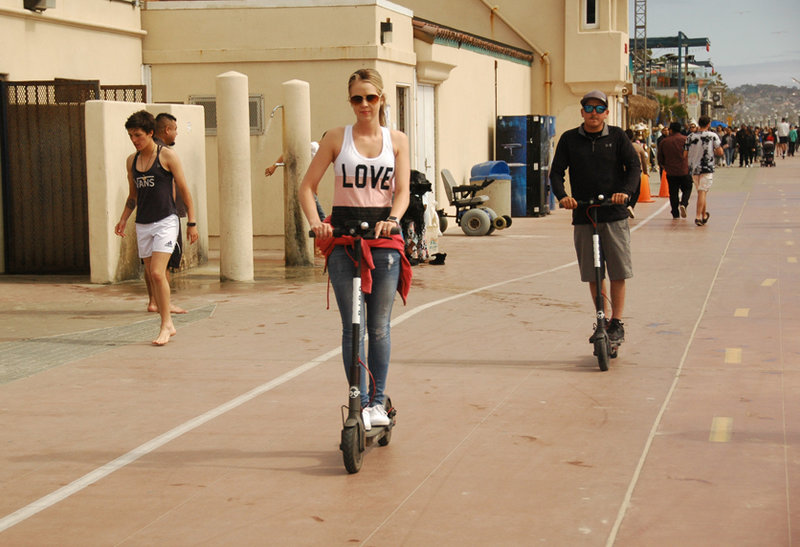
A crackdown to enforce motorized scooter safety, especially in Pacific Beach and Mission Beach, will continue this summer to curb offenses by people riding without a helmet, on sidewalks, or intoxicated.
This recent announcement by police follows in the wake of last month’s City Council vote opposing an emergency ordinance prohibiting motorized scooters on coastal boardwalks.
District 2 Councilmember Lorie Zapf, District 1 Councilmember Barbara Bry, and District 5 Councilmember Mark Kersey joined to support a scooter boardwalk ban. Council members Chris Ward, Myrtle Cole, Scott Sherman, Chris Cate, David Alvarez and Georgette Gomez all opposed the proposal, arguing they weren’t convinced of its necessity, or that they felt the issue hadn’t yet been properly vetted. Sherman said the problem was more about irresponsible riders than about vehicles being ridden.
The dockless bike and scooter craze, many of the vehicles motorized, has swept over coastal areas since the transportation mode first surfaced in San Diego in February. Ever since, the police and local government have been grappling with a growing number of complaints about numerous alleged electric scooter violations. The vehicles, which can travel up to 15 mph, are easily able to exceed the 8 mph boardwalk speed limit.
In the wake of the thumbs-down vote on prohibiting motorized scooters on coastal boardwalks, a City Council committee, chaired by Bry, has agreed to form a working group to explore creation of a permit and fee system for four dockless companies – Ofo, Mobike, LimeBike and Bird – operating citywide.
The apps of some dockless companies, like Bird, note riders are required to wear helmets, have a driver’s license, be 18 or older, and obey all other local traffic rules.
According to a City of San Diego alternative vehicle information brochure, electric bicycles must follow the same rules of the road as non-motorized bicycles. Electric bikes have been divided into three categories: Class 1, pedal-assisted only maximum 20 mph; Class 2, throttle-assisted only, maximum 20 mph; and Class 3, pedal-assisted only, speedometer required, maximum 28 mph.
Riders of electric bicycles are not required to have driver’s licenses, but are required to wear safety helmets, including their passengers. If ridden during darkness, bikes must have lights. Their operation is restricted to streets with speed limits of 35 mph or lower. Such bikes are legally allowed to go up to 15 mph. An intoxicated rider on an electrically motorized vehicle can be cited for driving under the influence of drugs or alcohol.


