


One libation lover’s frolic through the spirits
By Erik Dobko
Science and alcohol have always brought me great satisfaction, but until recently, have been rather mutually exclusive. I suppose I have played a drinking game involving Neal deGrasse Tyson’s neckties, but no union of the two has ever really existed beyond that.
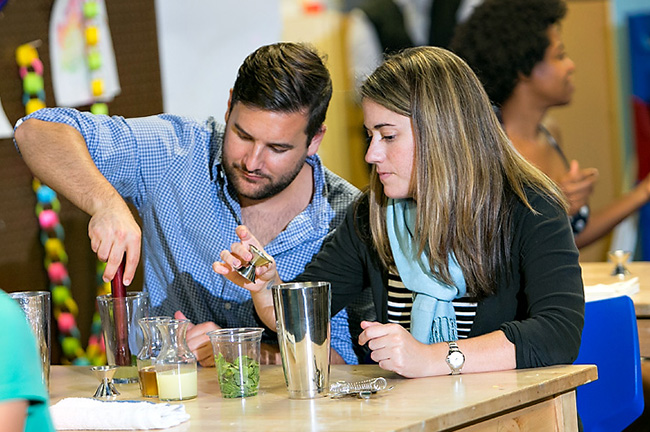
On the night of Oct. 16, however, these timeless revealers of truth were stirred together in Balboa Park for another edition of the Reuben H. Fleet Science Center’s adult-themed “Science on the Rocks” parties — this time called “The Science of Spirits: Craft Cocktails.”
The event featured a wide variety of experts able to answer my most pressing alcohol-related questions, as well as an abundance of liquor to ensure that the information would not be retained. According to my voice recorder, it was quite a stimulating bash. Tasty food and drink could be found in every direction, interspersed with local scientist graduate students volunteering at the event for the chance to show buzzed yuppies how much smarter they are than them.
Distillers from Old Harbor Distilling Co., Twisted Manzanita Spirits, and Ballast Point Spirits came by to share their latest experimental products and delve into the process that brings them all to life. Catering was also provided locally, including sample dishes from South Park Abbey, Glass Door, and Sadie Rose Bakery Co.

The first eye-opening exhibit I stumbled upon was a beer-goggle obstacle course. It ultimately taught me that no matter how much I drink, I will at least still be more coordinated than the time I saw the world through a disorienting pair of lenses seemingly cut from a tinted funhouse mirror. In another, I learned the backstory of the term “proof,” which was derived from 18th century traders that would set fire to a small portion of another trader’s product to thereby prove its potency. One colorful display dealt with the role of density in making layered cocktails, showing how the more sugary parts sink to the bottom while the more alcoholic parts float to the top, as was demonstrated by a cocktail resembling the Dutch national flag.
An exhibit on infusion ventured into how distillers draw out the color and flavor of various foods into alcohol in order to give it more character. Volunteering at the exhibit, UC San Diego assistant professor and cancer genome researcher Hannah Carter shared her exposure to the brainier side of booze.
“I once visited a nitro bar where they were using membrane-forming solutions and dropping alcohol into it to create these shots that looked like an egg yolk. It was being run by a chemistry graduate student,” she said. “He was making crazy gelatins, super-heated foams, liquid nitrogen — just bringing chemistry into beverage mixing in a unique way. But it requires a lot of expertise that I don’t think any bartender can do; you need to know enough not to kill your clientele.”

With decadent food, delicious craft cocktails, and a tornado simulator, what else can one ask for? After having thoroughly acquainted myself with their new line of gin, Old Harbor’s Vice President of Operations Richard J. Warner filled me in on more fun facts regarding the distillation process.
“Liquor is really interesting, because really what you start off with is something around the percentage of wine or beer — between 10 and 15 percent — but what you do is, through heat, you create vapor, and because alcohol and water have different boiling points, the alcohol boils off first,” he said. “We capture that alcohol and create a solution that now has 80 to 90 percent alcohol.
“Also, all alcohol that comes out of a still will be clear,” he added. “If you see anything with color, it’s come from either aging, or the color has been added by a distiller.”
And just when I thought I’d heard it all, volunteer Andre Dharmawan had the audacity to question our culture’s shining beacon of hedonistic overconfidence, James Bond. While likely no expert in disarming nuclear warheads or dallying secret-agent supermodels, Dharmawan did have something to say about 007’s clichéd drinking habit.
“So everybody should know the story of James Bond: he likes his martini shaken, and not stirred,” he said. “However, in the field of mixology, it’s actually a travesty to shake your martini. The martini is made from gin, and gin has chemicals that impart a lot of flavor, complexity and aroma, and when you actually shake your gin or martini you’re cleaving those chemicals into other chemicals that impart no flavor, no complexity, and no aroma whatsoever.

“There are actually a couple of possible explanations why he wants his drinks shaken,” he said. “One explanation is that shaken drinks are lower in temperature. Another is that the ice imparts a lot more water onto the drinks, and so the drinks are more diluted compared to their stirred counterpart. And because he’s always on a mission, I’m assuming that he wants to have his focus, he wants to be alert, and so he wants to have a more diluted drink.”
The event was the seventh installation in the “Science on the Rocks” series, which has been host to a litany of themes including the science of beer, the science of chocolate, and the science of sex. While this was the last one of the year, fret not, for there are many more to come.
If education and inebriation sound like your kind of mix, then it’s definitely a party worth experiencing; because if there’s one thing that chaotic pendulums, electric arc controllers, and phenakistoscopes all call for — it’s another round.
For more information about R. H. Fleet Science Center’s “Science on the Rocks” series, visit rhfleet.org.
—Erik Dobko is a freelance writer and a student at San Diego State University. Contact him at [email protected].


