


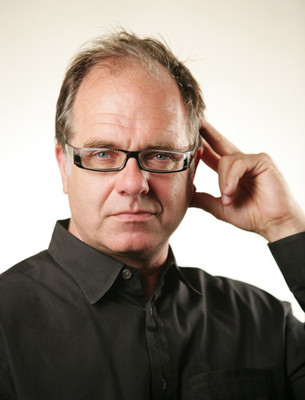
With new music director Steven Schick firmly ensconced on the podium, La Jolla Symphony & Chorus launches its 2007-’08 season with an extremely exciting program this weekend at Mandeville Auditorium on the campus of University of California, San Diego (UCSD), in La Jolla.
Aside from the new maestro, the inaugural concert’s big excitement is the American premiere of Philip Glass’s Cello Concerto with New York-based artist Wendy Sutter, heard here last season in Tan Dun’s Cello Concerto with Schick wielding the stick. Also programmed this weekend are Alaskan composer John Luther Adams’ “The Light That Fills the World” and Ludwig van Beethoven’s Fourth Symphony.
How LJS&C happened to capture the American premiere of the Glass concerto is an interesting story and has to do with Sutter’s relationship with the orchestra. According to Schick, the cellist had such a good experience last season that she wrote a letter to the entire orchestra saying she was moved by the way everybody listened and responded to her.
“Then Philip offered her the American premiere of the piece,” said Schick, “and asked where she wanted to play, and she said, ‘With the La Jolla Symphony.’ He listened to the recording of the Tan Dun and told me, ‘It’s a very, very good orchestra,’ and I thought, ‘Well, we’ll be fine, then.'”
The 2001 work was commissioned by Julian Lloyd Webber for the Liverpool Philharmonic and premiered just after 9/11, an anomaly that Schick feels may account for the fact it has not been performed in the U.S. until now. According to New York Times music critic Allan Kozinn, quoted on Webber’s Web site, “The concerto should be an entirely unsuitable form” for the composer. “By its nature, it requires a showy virtuosity.” Kozinn states further that ¦even in his post-Minimalist, neo-Romantic phase” Glass’s music “has been more about the power of the ensemble than the glorification of the soloist.”
The work opens with what Kozinn terms a twisted Bachian theme, then cycles into something quite un-Glass, filled with what he terms haunting lyricism. The composer, who has never heard the work, will be present at Saturday’s concert in La Jolla.
As for “The Light That Fills the World,” Schick said the composer is less concerned with rhetorical music, where there are melodies and harmonies, and much more concerned with the environmental soundscape he builds.
“It’s a series of changing notes and colors that build and ebb and flow, like watching light on the waves,” Schick said. “You think there’s one thing that doesn’t seem to be moving, and when you listen more carefully you realize you’re hearing 90 separate parts. It’s a fascinating world and in a harmonic sense, very beautiful, like being in the middle of a snow globe if those things were sounds instead of flakes.”
Schick said that it’s difficult to think of Beethoven as underrepresented in the orchestral repertory, but that the Fourth Symphony, 200 years old this year, is one you could go a long time without hearing live.
“He lived at a time of unbelievable, almost volcanic change, a time in which he had inherited strong musical ideas and forms,” he said. “There’s a battle [within the symphony], and in fact within all his music, between rhythmic and harmonic dissonance and formal containment and purity. For me, it’s really important to pair the work with John’s and Philip’s works because for Beethoven it’s also a piece about choices.”
The wise and curious are urged to attend this unusual juxtaposition of 19th- and 21st- century works at 8 p.m. Saturday, Nov. 3, and 3 p.m. Sunday, Nov. 4, at Mandeville Auditorium, UCSD, 9500 Gilman Drive.
For tickets and information, visit www.lajollasymphony.com or call (858) 534-4637.


