


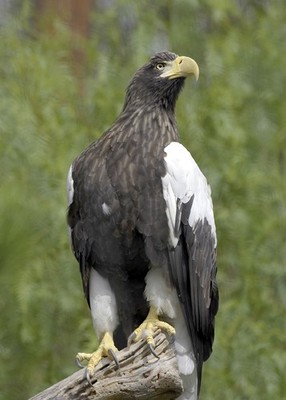
Northern Siberia’s Pacific coast is a rugged, unpopulated land, crisscrossed with rivers and steep ravines and covered in six feet of snow for several months each year. This region is the only area in the world inhabited by the majestic Steller’s sea eagles.
The Conservation Research and Endangered Species Center (CRES) of the San Diego Zoo has teamed up with scientists from Natural Research Ltd. to study juvenile Steller’s sea eagles through an innovative new research program. The program started in the summer of 2006, when scientists from Natural Research tagged five Steller’s eagles nestlings with long-lasting satellite tracking devices which will allow the researchers to chart the lives of these birds over the next four years.
Mike McGrady, one of the scientists from Natural Research leading the project, described their progress at a seminar at CRES in January. According to McGrady, this project is innovative because no one has ever tracked young eagles of any species for such a long time.
“We know almost nothing of what any eagle does in the first four years of life,” he said. Related to bald eagles, Steller’s eagles are the largest members of the eagle family, and are best known for their prominent beaks, which are used to tear into frozen deer carcasses. Since these eagles live in such a narrow range, their population is tiny, estimated to be 3,500. In comparison, bald eagles number more than 100,000.
When studying eagles, including bald eagles, scientists have traditionally focused on the adult, breeding populations, which return to the same breeding grounds every year.
Curiously, young, immature eagles don’t live with the adult eagles in the breeding grounds, and no one is quite sure where they live during this time. That lack of knowledge will soon be filled as this program monitors the early lives of Steller’s sea eagles.
This information can be crucial in terms of the conservation of Steller’s eagles. They are listed as vulnerable by the World Conservation Union, and although their populations are not yet declining rapidly, their limited habitat is threatened by global warming and development for energy needs. By monitoring the juvenile eagles, said McGrady, scientists will know immediately if the species starts to decline. If they only monitored the adults, an entire generation could disappear before anyone noticed.
In addition, the Steller’s eagles are an “umbrella species” in conservation terms. Said McGrady, “By conserving the Steller’s eagles, because they require a relatively large area, we can actually extend the conservation over a larger number of species and habitat types.” The monitoring of these eagles will not only help the eagles but all other animals that live in the same area.
Since the nestlings were tagged last summer, McGrady and others at Natural Research have been tracking their migrations. Eugene Potapov, the other main scientist involved in the project, described how they used the data they gathered in a way that has never been done before. Potapov layered the migratory data of the young eagles on top of satellite images from Google Earth, which reveal snowpack and ice cover. By combining these two sets of data, the researchers were able to observe how the eagles left the nesting grounds and flew south, staying just ahead of the snow and ice, except for one eagle which remained near a large river that never froze over.
Already within the first year, this program is providing unprecedented detail into the lives of these juvenile eagles. Anyone interested can track the day-to-day movements of these eagles from their own homes by visiting the zoo’s Web site, www.sandiegozoo.org/news/stellers_sea_eagle_tracking.html. Also, a breeding pair of Steller’s sea eagles make their home at the San Diego Zoo and can be seen there.
The partnership between the San Diego Zoo and Natural Resources has been beneficial for both groups. McGrady and Potapov are the world’s experts on Steller’s eagles, but before partnering with the zoo they were mainly focused on research, not conservation. David Rimlinger, curator of ornithology at the San Diego Zoo, described how the zoo became interested in a conservation effort involving Steller’s eagles. “For us to start a project like this from scratch would be very difficult. So rather than do that, we decided to seek out the experts.” Natural Research welcomes the chance to apply their research to conservation, and the San Diego Zoological Society is happy to put its solid research foundation to good use.
To read more about how science impacts our lives, visit Matthew Busse’s blog, www.science-translator.com.


