



No alarms sound, 12 residents displaced
By Rick Braatz | SDUN Assistant Editor
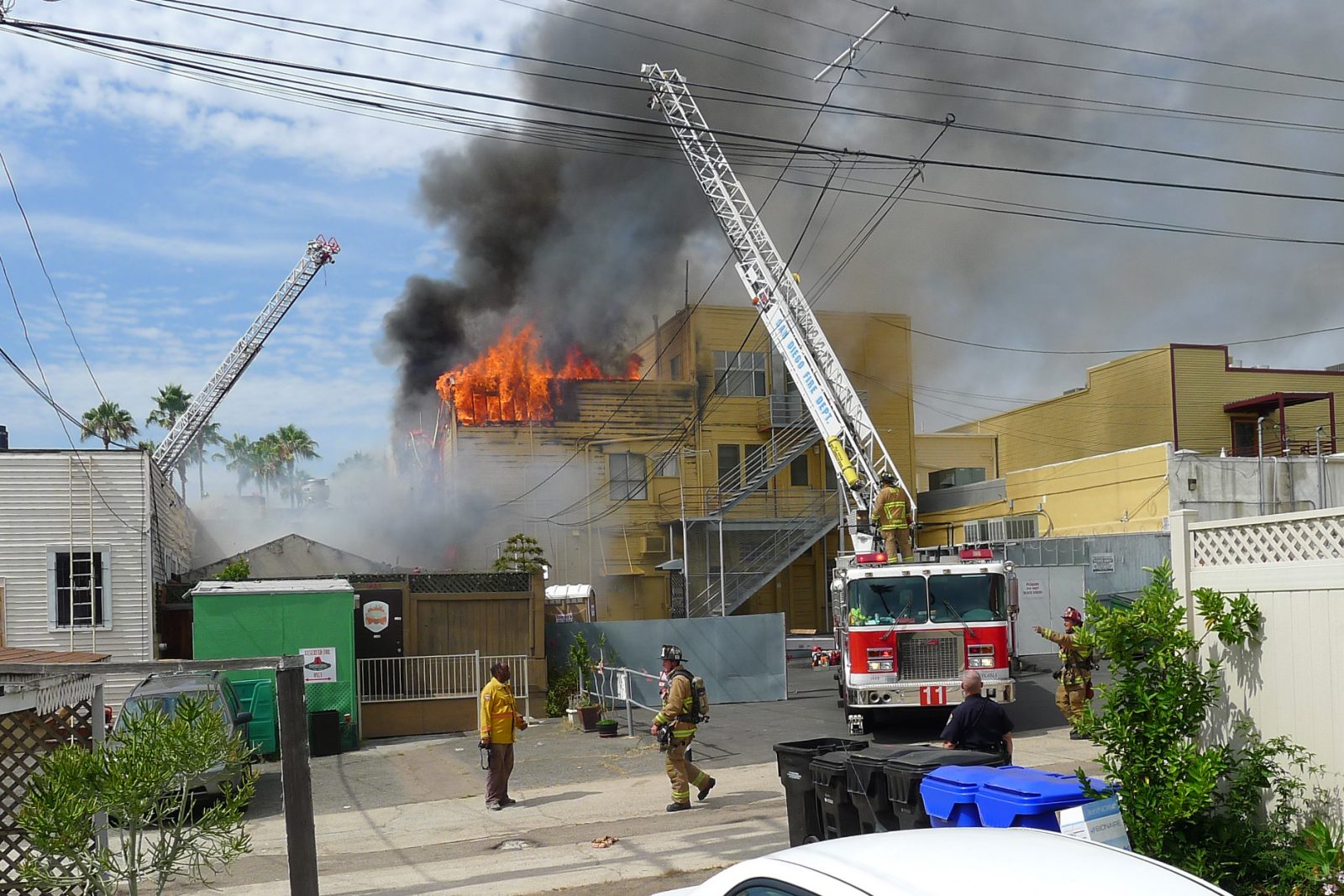
Roofers working on Hillcrest Italian eatery Buonissimo 2 ignited a three-alarm fire (requiring extensive resources) next door to an apartment complex above Obelisk gift shop on Wed., July 6, at approximately 3 p.m.
“They were doing roofing work for the last couple of days, and … they were using a torch to lay down the new roofing material, and that open flame ignited the side of the apartment building, and it ran into the floor and into the walls,” said Maurice Luque, spokesperson for the San Diego Fire-Rescue Department, who was at the scene.
Four fire engines rushed to 1033 University Ave. after the department received a call about an apartment fire on the second floor of a 15-unit apartment complex above Obelisk and Torreon occupied by 12 residents, two of whom said no alarm sounded in the building.
Police blocked off University Avenue between 10th Avenue and Vermont Street so firefighters could enter unobstructed, but Luque said they couldn’t get to the seat [main body] of the fire.
“The visibility was very limited. A lot of smoke and … heat, and they kept trying to attack the fire. They did have hose lines and they were getting some water on the fire. But it was just too intense and it was too involved,” Luque said.
About 20 minutes later, the crew had to exit the building and tackle the flames from outside. Personnel deployed 900 gallons of water from three fire engines’ hydraulic ladders (two in front and one in back) for an hour to assist them.
Still concerned, however, that the fire would soon spread to neighboring buildings, the crew called for back up. A total of 14 fire engines, six trucks and 113 fire personnel were deployed to the scene before, at 6:30 p.m., crews succeeded in extinguishing the blaze.

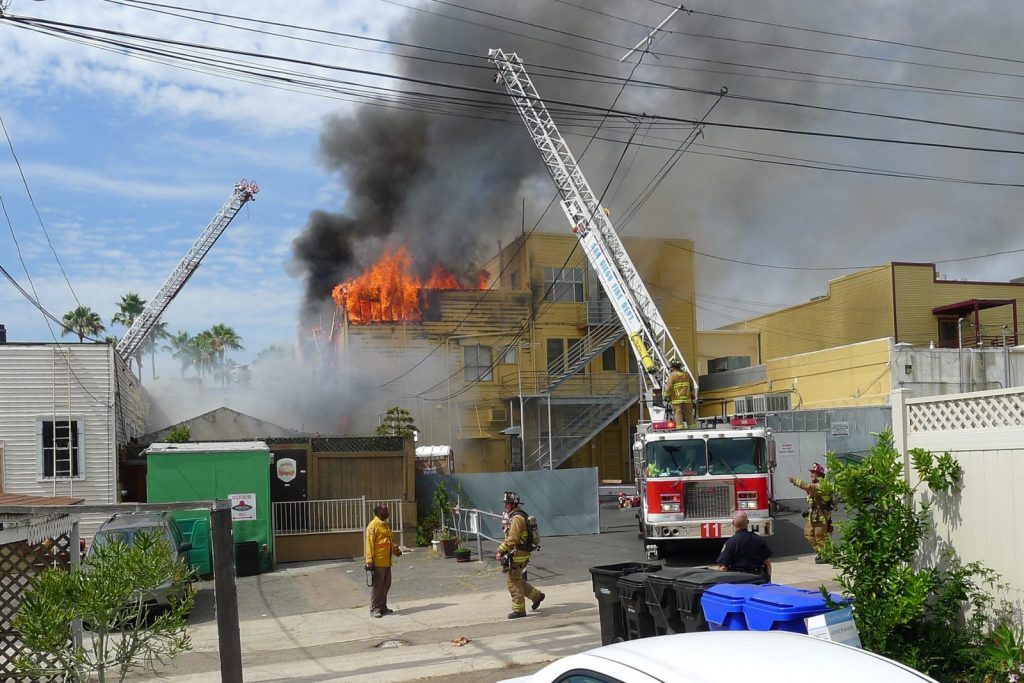
- Fourteen fire engines deploy to a Hillcrest apartment fire. Wed., July 6.

Obelisk and another business below the apartment complex, Torreon Importers, suffered extensive water damage, in addition to some structural damage, said Luque, adding that total loss to the building and its contents is estimated at $1 million.
“The information we’re getting is that most of the building is gutted,” said Jessica Dietrich, a lead case worker for the Red Cross. Dietrich and staff set up operations outside the Hillcrest Pick Up Stix to help residents, all 12 of whom were displaced by the fire, deal with their loss and find shelter.
“Our main goal is making sure they have food, water, a place to stay, and helping them onto that long-term recovery,” Dietrich said. Evan Knopf, 22, lived in one of the apartments.
“I was in the building when it happened. I was working on job applications, and I started to smell smoke, but I thought maybe it was incense or something from one of the neighbors. But then all the electricity in the building went out, like my fan stopped, so I was kind of like, ‘what is going on?’ and I actually heard people—because I lived in the front—screaming on University Avenue ‘Someone should tell the people in the building that its on fire.’ And I didn’t realize it was our building at first because none of the alarms were going off and actually went to the hallway and it was already filled with smoke,” said Knopf, adding that he then ran outside.
“This is an apartment building full of working class people and students, like I don’t think any of us, except like one resident, had renters insurance. So I mean,s for most of us I think it’s a total loss,” Knopf said.
Francisco Huicochea, 51, also lived in the building.
“I was taking a shower, getting ready to go to work, and I smelled smoke. But then I thought it was outside, or you know they have construction. I’m like, ‘Maybe something’s going on?’ And then somebody was yelling in the hall,” said Huicochea, who then also ran outside to safety.
“No alarms, nothing went on. I just wonder what would have happened if I had been asleep. I take medications that make me sleepy, and if I been there, I would have never heard anything. It’s really scary when I think about it. I’m glad that it at least happened in the day,” Huicochea said.
The fire required such extensive resources because the building, constructed in the early 1900s, wasn’t built with fire-resistant materials.
“They built them very strong in those days but at the same time they didn’t have a lot of the fire safety features that modern construction has, meaning there are no fire blocks in the walls. The floors aren’t sealed off, so fire gets in those hollow walls and it just travels up and … horizontally very, very quickly,” said Luque. “And of course, it’s a wood structure; it burns quickly. Its lath [wood] and plaster inside, which is the very old style. It’s not fire-resistant dry wall.”
The following morning, Thurs., July 7, Luque said the city’s building inspector had red-tagged the building, meaning no one is allowed to enter it due to the severity of the damage.


