


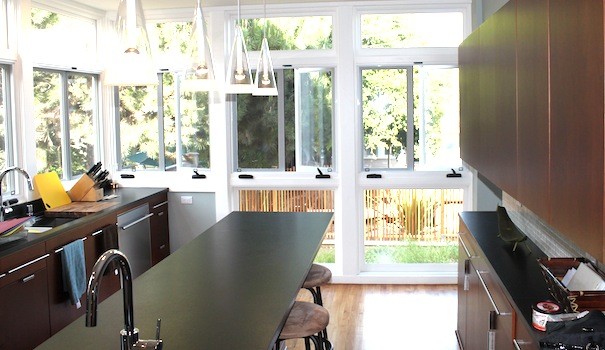
Take a deep breath. Listen to your feelings. Journey from ignorance to uncertainty to perfection. This is the Zen of home remodeling.
Michael Good | HouseCalls
Not every old house is historic. And not every room in a historic house can or should be preserved. With no place for a refrigerator, dishwasher, convection oven, toaster oven, wine refrigerator, warming drawer and espresso machine, most 100-year-old kitchens can’t be adapted to modern living. If you absolutely need this stuff, then you’re going to need to remodel. For that, you don’t necessarily need a restoration specialist. You just need a really good contractor — one who understands old houses (and old house owners). But Low does one find such a person, and make such a project successful?

I talked to a number of contractors, tradesmen and craftspeople for advice about making your home-remodeling project successful. Although people in the trades love to complain privately about the crazy things their clients do, the guys I talked with were too savvy to do it on the record. All their clients were paragons of wit and civility. Here’s what they did have to say, however (with my own insights as a restoration specialist and old house owner).
Just say no.
“Don’t do it!” shouted one contractor when I asked for his advice for remodelers. He was laughing, but he wasn’t kidding. It’s always a good idea to question yourself before starting such a big undertaking. Remodeling is extremely stressful. It’s disruptive. It tests relationships. It tests sanity. Even when things go well, you’re likely to have some dark nights of the soul and learn some things about yourself, your partner and the many colors and textures of grout that maybe you didn’t want to know.
Live with it first.
A lot of people remodel before they move in. It seems a practical time to do it, while the house is empty and everyone is filled with ambition and ideas. But it’s easy to make a mistake and tear out something that actually worked beautifully and looked beautiful. Try adjusting your lifestyle to your house. That’s the way the experts — people like SOHO Executive Director Bruce Coons — do it. Buying a new house is an adventure. Part of the fun is adapting to your new house, new neighborhood and new lifestyle. Sometimes, we can learn a few things from our houses. Other times, the reality is: You really do need a bigger closet.
Do your homework.
Everyone wants to control costs, get it done fast and get the best possible quality. But not everyone wants to do the work. Some would rather negotiate a better price, discover a clever trick, find a new cheaper miracle material, hear about a guy who knows a guy who does a thing for an incredible price and hire him. But there is no such thing as a brilliant uninformed decision. That’s crazy talk.
Before you start interviewing contractors, craftsmen or tradespeople, give some thought to how you really live your life (not the way you imagine you’re going to live it after your remodel, when you magically start entertaining three times a week). If you’re remodeling your kitchen, go through the steps you will go through every day to make your breakfast, your lunch, your dinner — walking between your imaginary new refrigerator, your stove, your two sinks, your cooktop, your towel warmer. Research historic colors, historic design and kitchen ergonomics, examine the architectural details of your house as it is and decide if you want to use those details (hardware, molding, lighting) in your new project. It’s not enough to pick up some color swatches from Home Depot — buy some paint, put it on a small piece of drywall, move it around the house, put the colors next to each other. Think things through. You’re going to feel under a lot of pressure once the project begins, and making wrong decisions, slow decisions or no decisions can be costly and frustrating.
Accept the fact that you don’t know how much it costs.
America is crazy about getting a deal. A recent study of Black Friday prices revealed that Americans will buy almost anything that’s marked down 70 percent. And they turn up their noses at anything that isn’t marked down at least 40 percent. But the typical Black Friday item was marked up before being marked down. Many a flat screen TV sold for less in the spring than it did in the fall on Black Friday. Consumers can’t get a great deal because they don’t know what a flat screen TV should cost. They don’t know how much the materials cost, how much the labor costs, how much the marketing costs, how much it costs to keep changing the price tags.
If you don’t know what a flat screen TV should cost, how can you know what a kitchen remodel should cost, with its half-a-dozen major appliances, plumbing, electrical, tile, trim, flooring and a million other little components and details assembled by a small army of technicians, craftsmen, laborers and paper-shufflers? The three-bid method of selecting a contractor or tradesperson is just wishful thinking. Contractor A has the best price. Contractor B can do it fastest. Contractor C can deliver the best quality. After the wily homeowner gets his three bids, he thinks, I’ll negotiate with C to get him to do it as fast as B and as cheap as A. That’s impractical thinking. And if you persist in that, contractors are just going to tell you what you want to hear, and adjust either the quality, the timeliness or the price through excuses and change orders to bring you face to face with reality and satisfy their bottom line.
Wake up, smell the coffee.
“People are delusional,” said Michel Khozam of ZMK Construction with a laugh. (Laughter seems to be the universal reaction when I asked contractors how homeowners could make their project go better.) Khozam was a systems engineer when he started flipping houses.
“But I fell in love with it. I became very fond of the idea of preservation. People who buy older homes are wired differently,” Khozam said. He should know; he owns one himself.
Old house owners are committed to the idea of the house as home, not an investment, he said. But even with the preservation-minded, “there’s always that variable, of being delusional about the outcome. They under-estimate the disturbing costs involved in restoring a home. We can design everything to accommodate your modern needs on the inside of the house. But all designs are predictions. And all predictions are wrong. When I say that to my clients, they look at me and say, ‘What they heck are you talking about?’
“Once you have a conceptual idea of what it should look like, we hire an architect,” Khozam continued. But the plan is what it is: a conception. With that, the clients have a warped sense [of the outcome]. It takes me back to the word I used earlier, delusional. That’s how they are looking at it. It’s my job to minimize that.
Hire someone you like and trust.
“You’re going to have a very close relationship,” said Shawn Woolery of San Diego Sash. “You might as well spend your time with someone you like.” Woolery manufactures windows and molding for historic houses, but more importantly, he has gone through the personal agony of his own whole-house remodel. When I ran his comment by Khozam, he agreed, but added that “Likeable doesn’t mean they are highly competent.” So what should a homeowner be looking for?
“It’s a feeling,” Khozam said. “A feeling you get, a feeling the clients get toward someone. On many occasions, it’s me; my knowledge about their home, details, the client’s needs and wants … it’s an emotional response. “That’s how you choose. Our decisions in life are based in emotion. When people are spending a lot of money, it’s very emotional. This is their life savings. It’s the future of their kids. If they are going to be spending it, they better be spending it for the right thing.”
“As Mark Twain said, ‘Education is the path from cocky ignorance to miserable uncertainty. The outcome is always uncertain,’” said Khozam.
In other words, Grasshopper, change is inevitable (and often painful) as the process moves from your bold idea, to the architect’s drawing, to three-dimensional form, to the inevitable something you hadn’t imagined, but actually really like.
“If someone’s seeking perfection — that’s a good goal,” Khozam said. “But perfection is reached at the end, not the beginning. That is the outcome of most projects. The anxiety has been building up for so long, once the clients see the finished product they become awestruck. We arrive at perfection. Don’t seek perfection during the process. We’ll find it at the end.”


