


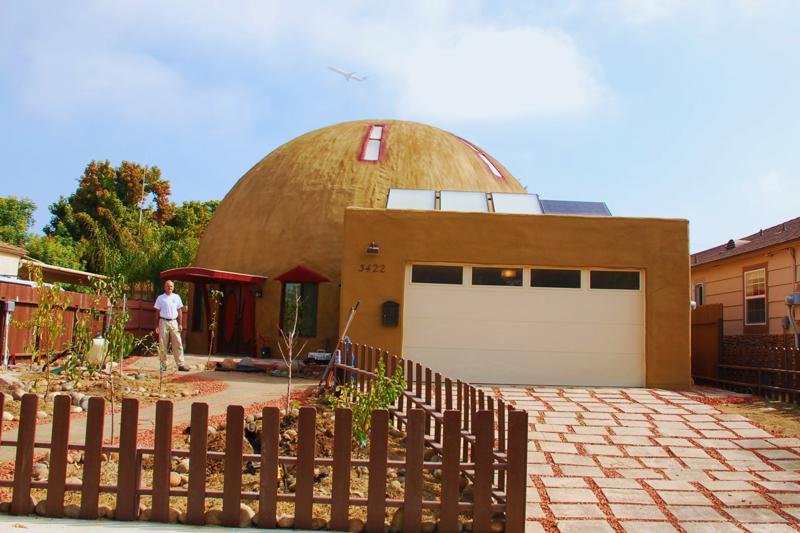
A half-century after R. Buckminster Fuller connected a series of triangles to build America’s first dome home in the woods of Illinois, Hal Brody has married modern technology with environmental materials and Old World décor to construct his own geodesic dome, which he calls “the greenest home in San Diego.” His single-family residence will be open to the public from 10 a.m. to 7 p.m. on Sept. 24 and 25 in the heart of Point Loma at 3422 Sterne St. (Don’t worry, you can’t miss it.) Brody, 67, has spent a decade researching and designing the light-gauge steel structural sphere, and the last two years building his vision of the eco-conscious domicile of the future. “First, I wanted to do the best I could to be a good environmental steward — to use the best materials that last for years, and the least amount of energy to maintain,” said Brody, who will use his home to educate contractors on how to incorporate environmental systems and materials into their buildings. “Architects will then have the ability to create homes that contractors can build,” he said. If he achieves his goal of having five crews build two dome homes a year in San Diego, there will be plenty of work to keep everyone busy. An anomaly amid wood-framed dwellings on manicured lawns, the dome has created a controversy of appropriateness in one of the city’s oldest neighborhoods where conformity and convention are valued. “Plenty of people build rectangularly — that’s been done. I’ve been doing things different all my life,” said Brody, who moved to San Diego in 1968 from west L.A. “I’m not going to change now.” Brody steps aside to watch visitors’ expressions when he opens the door to the 2,235-square-foot four-bedroom, two-bath home. “There’s an emotional reaction. Almost everyone has one,” he said. “Vaulted ceilings are inspirational.” From the first-floor threshold, the sky-painted ceiling on the second floor commands the eye upward. A single continuous interior wall curves seamlessly up and around from the dome’s fly ash and cement foundation and radiant floor heating (no forced-air duct system in this house). Sunflower seed shell board, wheat board, biocomposite, bamboo and walnut shell phenolic make up countertops, shelves and tables. Brody personally cut the curved 12-foot-long dining room table. The tongue-and-groove shower walls aren’t wood, but high-density polyethylene (HDPE #2 – recycled milk cartoons and plastic bottles.) “It’s very expensive, but it’s forever,” Brody said. When natural light filtering through double-pane windows and six skylights isn’t enough, dimmable LEED lights illuminate the house in sections. “My grandkids will be using the same bulbs,” Brody beamed. Closets are enclosed behind curtains because doors require more materials and take up too much space. The two toilets have the privilege and privacy of the home’s only interior doors. Outside, a greywater system pumps recycled bath and shower water (from low flow faucets) to the food-bearing landscaping. In the front yard the showiest trees have been planted near the brown picket fence. In the back yard a 24-foot-long raised bed is one of three gardens that will easily sustain Brody’s vegan lifestyle. Solar panels harness the San Diego sun. “The goal is to generate 100 percent of our needs,” Brody said. But a back-up hot water heater is on standby in case of a cloudy day. Walkways are made from the original concrete driveway or compressed stabilized decomposed granite. Even the 60-year-old, 1,000-square-foot house that was on the lot when Brody purchased it in 2007 lives on in southeast San Diego. Brody estimates the construction costs for a basic dome home on a ready-to-build lot at $450,000 — or $200 per square foot. Environmental systems like solar and greywater are extra. While neighbors admire Brody for his earth-first approach, they tried to stop the dome. First they called the city’s planning department to complain. When that failed — the structure passed the test of strength and durability — they circulated a petition asking Brody to conform to the rectangular norm. “I do feel bad if people’s aesthetics are offended,” Brody said. “The objectors appreciate sameness and have a value for continuity. I don’t share that opinion; I like to see difference in architecture,” he said. “Weird is OK — as long as it’s not ugly.” Not to mention a rectangle does require more materials than a circle to create the same amount of space. As for putting a dome home in the heart of the city: “This is where I want to live. I want to create infill, not be part of urban sprawl,” Brody said. “This house doesn’t belong in the woods. It’s a feature in the neighborhood.” While debating rectangular vs. round, keep in mind the bigger question people ponder when moving to this neighborhood is if they want to live under the flight path of an expanding airport.


