


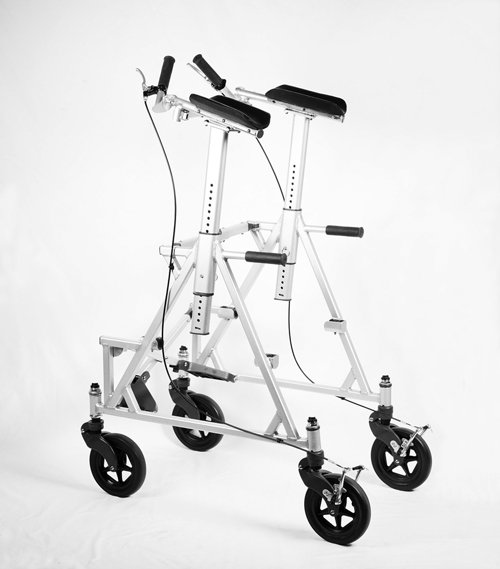
Longtime Point Loman Dave Purcell is working on his fifth start-up company, Prostar, which is busy outfitting LifeWalker Upright, an improved walker to assist the aging and disabled.
Purcell, age 77, and his wife, Jean, have lived in the Peninsula for 34 years. The couple have been retired 12 years and had no intention of getting back into business.
But “something” came up.
That something was serious problems that Jean, who has had 16 spinal surgeries as well as rheumatoid arthritis, developed with her walker, which she relies on.
“My wife’s been using a walker for several years and she’s fallen on it, and that’s hard to take when you love someone and what she depends on is inadequate, having to walk behind it and not feel safe,” said Purcell. “I thought, ‘I could do much better than this.’”
The problem Purcell decided to tackle was a real one. According to the National Council on Aging, one-third of Americans aged 65 and older fall each year.
There also was the challenge of improving upon a device many older people need to get around.
“Walkers haven’t changed (much) since 1953 when they were invented, more than half a century ago,” Purcell pointed out. “That’s crazy.”
So Purcell “attacked” the problem of redeveloping the classic walker. He pulled in experts and advisors in design engineering from his previous companies and UCSD Medical Center healthcare professionals specializing in orthopedics and spine surgery.
Together, Purcell’s team discussed safety needs in the design and how to incorporate the proper ergonomics (efficiencies) while balancing function and comfort.
Dr. Steven Garfin, a board-certified and world-renowned orthopedic surgeon and a member of Protostar’s advisory board, also played a significant role in these discussions.
Safety was Purcell’s top priority. Consequently, he undertook a video, with his wife as the subject, the results of which revealed many shortcomings with the design of the existing mobile devices.
Through several videos, Purcell began to understand the safety issues and the flaws of existing walkers and applied his learnings to develop concept drawings and specifications for Protostar’s walker.
“I used the computer to come up with a 3D design,” said Purcell adding that led to development of a mock-up of a better walker that users were then able to “test drive” for him to make further refinements.
“We had people try out the mock-up and say what they liked and didn’t like about it,” Purcell said. “What they said was they didn’t like walking behind it and pushing it like a wheel barrow, which they felt was unsafe, saying it (walker) needed to more upright. They tried the new walker, loved it, thought it was improved. A couple of them wanted to take it home.”
Purcell said the objective is now to move forward with creation of an actual prototype walker.
Purcell has filed for patent protection for the new device. He’s also formed a limited liability company with a board of directors to launch his prospective new start-up.
The LifeWalker Upright’s purported enhancements:
– Armrests that provide stability and support;
– Weight off-loaded from the spine, hips, knees, ankles and feet;
– Walk longer and farther;
– Improve your general health with exercise; and
– Stand upright and see the world again.
What are the next steps for Purcell with his new-and-improved walker?
Protostar launched a Kickstarter campaign (www.kickstarter.com) on Sept. 10 to raise $150,000 to bring the device to market.
“It will be sold in clinical settings – hospitals, rehabilitation centers, skilled- and assisted-living facilities and by physical therapists,” said Purcell of LifeWalker Upright, adding, “We’re going to Europe to set up distribution there.”


