


Most everyone recognizes Dr. Martin Luther King Jr.’s “I Have a Dream” speech, delivered at the Lincoln Memorial Aug. 28, 1963.
While that moment likely marked King’s most recognizable public appearance “” impressing a message upon a generation through the power of his words and presence alone “” it was just one of many appeals for reform made across the nation before his death in 1968.
Though King spent most of his time in the southeastern United States, the heart of the civil rights movement, he traveled to the West Coast to garner support for the Civil Rights Act of 1964.
On May 29, 1964, King stood in the auditorium of Cal Western University “” now Point Loma Nazarene University “” and spoke to a crowd of 3,500.
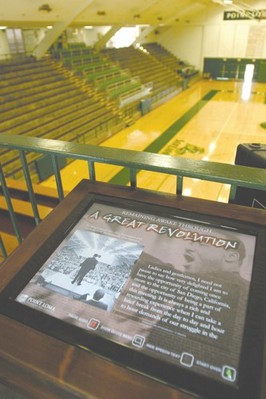
More than 40 years later, his speech, “Remaining Awake Through a Great Revolution,” can be heard once again in the halls of Golden Gymnasium thanks to an informational kiosk to commemorate the man and his legacy.
The kiosk, shaped like a podium, was unveiled and activated Friday, Jan 12, after a chapel service about Dr. King’s life delivered by PLNU professor Dr. Michael Lodahl. Its interactive touch screen allows visitors to scroll though photos of Dr. King’s life, speeches, and a timeline that shows the events of his life.
The kiosk project started about a year ago after PLNU alumni Alfred and Charlotte Chappell noticed a photo of King at what appeared to be their alma mater while looking through historic pictures at the Old Globe Theater.
The couple asked PLNU Alumni Director Sheryl Smee about the image and were amazed to find that King had indeed addressed the school. Smee agreed to contact other alums, among them Danielle Cervantes Stephens and her husband, Dave, to get the ball rolling on the informational and commemorative kiosk.
Cervantes Stephens was able to secure extra funding though her employer via the James S. Copley Foundation, which will match funds donated to educational institutions.
“It is important to teach every generation about the sacrifices and struggles of those that have come before us in their fight for what is right, even when it is against enormous forces,” said Ted Anderson, professor in the department of kinesiology. “This [kiosk] is a tangible reminder that a Southern Baptist preacher came here to this campus and asked this community for support in the fight against injustice in our world.”


