


Anyone who has a bulb has spring.
Bulbs don’t need much light; they don’t need good soil;
and they don’t need cosseting.
They are in fact, the horticultural equivalent of cats:
Self-contained and easy-care.
” Anonymous
Fall and early winter are the perfect times to begin planting many varieties of bulbs for beautiful displays of colorful spring flowers. As our nights become colder in November and December, the soil becomes a good temperature to plant bulb varieties such as amaryllis, anemones, daffodils, Dutch iris, freesias and ranunculus that love our mild climate. With a little advanced planning and refrigeration, you can also plant tulips and hyacinth.
Good quality bulbs are worth the money, especially when they naturalize in your garden, coming back each year with more flowers. I believe this holds true for amaryllis, daffodil and freesia bulbs, but I have also read that when purchasing tulip and hyacinth bulbs, it may be wise to purchase cheaper bulbs, since they will be tossed out after the season is over. Look for tulip bulbs that are at least 2 inches across.
Purchase bulbs that are not sprouting, without soft areas or signs of decaying. After purchasing your bulbs, store them in a cool, dry place before planting. Prepare your beds with organic mulch and a little organic blood and bone meal if they will be left in the garden to naturalize.
Bulbs come with all their energy stored inside to produce their flowers, so the little extra boost of fertilizer gives them nourishment for next year’s blooms.
Amaryllis “” We see these beautiful flowering bulbs forced for the winter holiday season, but the amaryllis also does great in the garden and will bloom in spring to early summer, if planted anytime between November and March. With amaryllis bulbs, bigger is definitely better. Plant with the pointed end of the bulb facing up, roots down. Leave at least one inch of the pointed end sticking out of the soil. Amaryllis bulbs naturalize in the garden or in pots, if given enough room to grow.
Anemones “” Plant in November, full sun to partial shade, in holes about 2 inches deep. Soak the bulbs in lukewarm water for approximately two to four hours before planting. Anemones will last a single season in our climate.
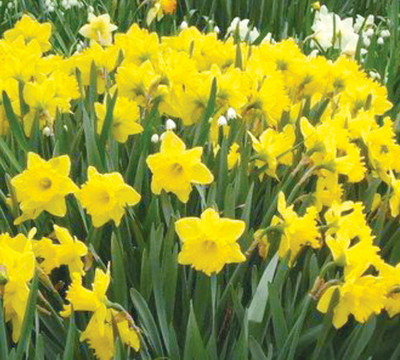
Daffodils – Plant in November through January, full sun to light shade in holes about 3-4 inches deep. Most of the daffodil bulbs you will find at our local nurseries will naturalize in your garden, providing more and more flowers each year.
Dutch Iris “” Plant in November, full sun to partial shade in holes about 4 inches deep. It is said that they may not come back each year. I have had them come back for a couple of years and then fade away.
Freesias “” Beautiful fragrance! Plant in November, filtered-sun to partial shade in holes 2 inches deep with their pointed end facing up. Should naturalize in the garden.
Ranunculus “” Plant in November, full sun in 2 inch deep holes. The “bulb” has a cluster of little fingers and the fingers should be planted facing down. When they are finished blooming and their leaves and stems have died back, dig them up and store in a cool, dry place until next planting season. You can place them in shallow containers with peat moss.
Tulips and Hyacinth “” Refrigerate (approx. 38 degrees) your bulbs for six to eight weeks before planting. Place them in a paper bag, not plastic and place them in your refrigerator’s vegetable bin, away from other fruits and vegetables. Begin refrigerating your bulbs in November for planting in January. Tulips “” partial shade in holes that are approximately 3-4 inches deep or two to three times the height of the bulb. Hyacinth (beautiful fragrance!) “” partial shade in holes 7-8 inches deep, pointed ends up in partial shade.
Bulbs are great for container planting, so you don’t need to have a garden to plant them ” a balcony, deck or terrace will work just fine. Plan to plant a few containers to bring into your home for a breath of springtime inside.
” Linda Marrone is a local realtor with Coldwell Banker who specializes in historic and architecturally designed homes. She is one of the co-founders of the Secret Garden Tour of Old La Jolla and enjoys working in her historic La Jolla garden. www.LindaMarrone.com “” 858/456-3224 (voicemail).


