


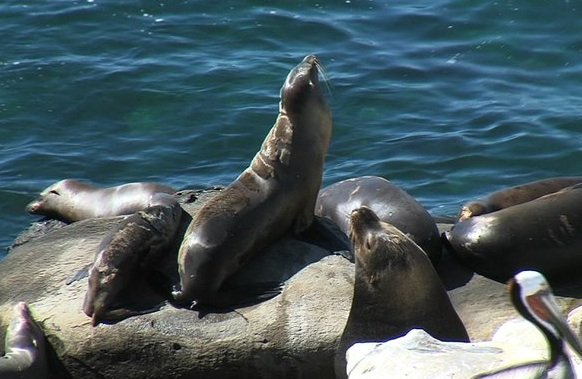
Given that the La Jolla coast’s burgeoning sea lion population (and the odor it fuels) is an increasingly vexing and persistent problem, the question now becomes: What can be done about it? A lively La Jolla Town Council discussion in April allowed community planners, residents, animal lovers and wildlife biologists to register their concerns about the gradual encroachments of sea lions onto the rocks and beach at La Jolla Cove.
The consensus at that forum was that most prospective deterrents to sea lion settlement are likely to work for a short time before the animals become accustomed to them and then ignore them altogether.
Seeking to find out what other affected communities are doing about these feisty pinnipeds, Village News contacted other areas along the West Coast to find out if — and how — they’ve found a way to “tame their lions.”
“Non-lethal deterrence is an option,” said Monica DeAngelis, a marine mammal biologist for the Los Angeles office of the National Ocean and Atmospheric Organization (NOAA). “However, sea lions are not as easily deterred as other animals. We are also getting pretty close to breeding season, so some males that are present may be exhibiting dominant behavior, which makes deterrence even more challenging. They may perceive the deterrence as a threat to their dominance and may not be as easily scared as, say, a younger animal.”
Astoria, Ore., like La Jolla, has a colossal problem with sea lions. Janice Burk, marina manager at the city’s Sea Lion Dock, agreed there’s no easy solution to controlling the behavior of aggressive sea lions settling in great numbers. But she said there is one thing that has been tried successfully.
“The best thing is activity on your dock and people pushing (not literally) them off,” Burk said, noting the sea lion problem there involves anywhere from 1,500 to 2,400 marine mammals monopolizing the docks.
“This year, they showed up two months early,” said Burk, who added the port did “a few different things” to dissuade them from coming in such large numbers.
“We put up some orange surveying ribbon,” she said. “It deters them, but it does not keep them from going through it if they want.”
Noting sea lions are “very curious animals,” Burk said the pinnipeds are confused by “something new or different.”
Burk said Astoria authorities have managed to keep one dock largely sea lion free by using the orange survey ribbons and by having “people live aboard their vessels and take it upon themselves to continually walk the dock,” which keeps the marine mammals away.
DeAngelis concurred with Burk that there is “no silver bullet” for deterring sea lions.
“That is why we suggest a toolbox of various deterrent methods rather than trying to only use one,” she said. “We’ve had very limited success when only one method is employed. It may work, but only for a very short period of time.”
DeAngelis also urged that any deterrence be conducted “by someone with some training and/or knowledge of sea lions.”
The marine biologist offered some insight into what might possibly be done.
“In this situation, the use of ‘crowder boards’ which are typically employed at rehab centers to corral animals at these care facilities to administer care without endangering the safety of the care givers, should be employed in combination with any other non-lethal deterrence method,” she said. “Once the animals are off the area, there needs to be some consistency to ensure that they don’t return.”
Burk said other methods have been tried unsuccessfully to deter sea lions in Oregon.
“We’ve tried fluorescent green heavier-duty nylon fencing,” she said. “We’ve also tried seal ‘bombs,’ used to make noise. We’ve tried sprinklers on the dock — but it doesn’t work for very long. We even had an electrical company out of Vancouver, Wash., design a mat they have used to deter sea lions on oil platforms. It didn’t work in fresh water the way it did in saltier water.”
Burk said officials are now constructing a railing system made with 4-foot-tall steel plates incorporating chicken coop wire or orange construction fencing.
“I don’t know that someone has the magic answer,” concluded Burk, adding that Oregon has had a serious sea lion problem for about 30 years. She pointed out the number of sea lions has “almost doubled every year in the last three years.”
“We certainly do not encourage the deterrence of (whole) populations, especially in their natural habitat,” DeAngelis said. “However, some of these pinniped populations are expanding their range, and I can certainly foresee more conflict in areas where humans and these expanding populations will overlap.
“It’s really a matter of being diligent,” added DeAngelis. “If animals begin to show up in an area, it’s usually a few at first, and that is when there might be more success at non-lethal deterrence. But it has to be constantly monitored. One can’t expect that one can apply a non-lethal deterrent and walk away expecting that it will retain its effectiveness.”
Noting that the presence of sea lions in La Jolla is “not new,” DeAngelis reiterated that “the public should be aware that these are wild animals. We can’t predict their reaction, especially if they are sick or attempting to establish dominance. They should keep their distance. Feeding them is not allowed, nor should the public take matters into their own hands and attempt to deter these animals.”


