


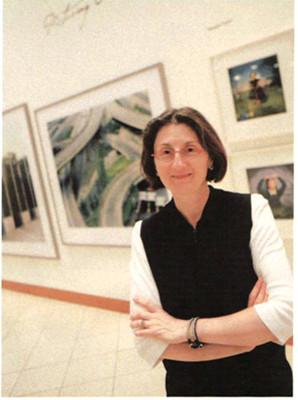
When you think of photography, there are so many extremes, from the amateur with a new digital camera to the selective artist attempting to paint life’s image.
Recently, we discussed the essentials of photography with Deborah Klochko, director of the Museum of Photographic Art, and asked the basic question: What makes a good picture?
“It’s an accumulation of elements,” said the lady who has taught, lectured and written extensively on contemporary photography and has curated more than 30 exhibitions.
“The image speaks to the viewers and excites them. Intense photography in a new and different way.
“To be a good photographer can be a very broad subject. You must be in the right place at the right time, whether its clouds breaking, the moon at a certain point or winter storms. Then you put the pieces together on the computer,” Klochko said.
She maintains that equipment is the least important factor in making a good photograph. Regional ideas are important in translating to an image that can impact and inspire a viewer.
The artist will do a great deal of editing an image as much as a writer will in painting a word picture.
“Artists have a mastery of their craft with lighting, camera angle and an understanding of the subject,” she said. “Some artists can even work with pinhole cameras, microvideos less than one inch square. Others can make photographs that don’t require cameras. It’s called photogramming.
This imagery is created using traditional silver-gelatin black and white materials and other photosensitive media, including cyanotype, that are considered alternative methods.
“Don’t use everything you shoot,” Klochko suggests. “But shooting a lot is important. I can’t think of any photographer who feels every image was great.
“In judging, what I might think is best may not [be] for another. It depends on the criteria. The digital camera has the potential to improve a photo, but it’s still a matter of making a choice,” Klochko said. “Obviously, with digital there is an immediacy to your results, but it can also make you kind of careless.”
The 34-year-old Center for Creative Photography is one of only seven in the United States devoted exclusively to photography. It came to Balboa Park’s Prado in 1983. It is accredited by the American Association of Museums and is a member-supported, private, nonprofit institution. Additional support is provided in part by the City of San Diego under a program managed by its Commission for Arts and Culture and the Community Enhancement Program of the County of San Diego as well as the California Arts Council and the National Endowment for the Arts. Excessive use classes, lectures, workshops and summer programs for adults are part of the agenda. Klochko is the author of “Picturing Eden” and “Moment of Seeing: Minor White at the California School of Fine Arts.” She co-authored “Create and Be Recognized: Photography on the Edge.” She is the former director of Visual Literacy, a private consulting business promoting understanding of photography. Her work with Visual Literacy has included consulting on the Smithsonian Photography Initiative Project.
For more information on the Museum of Photographic Arts visit www.mopa.org.


