


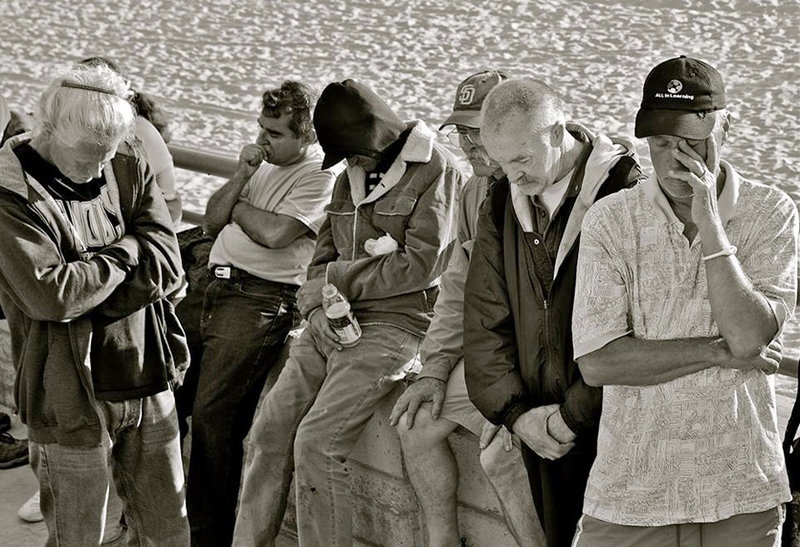
The face of homelessness in Pacific Beach is coming more sharply into focus these days thanks to the photographic work of Lisa Kanemoto of Bird Rock. As she’s done previously, Kanemoto has used her camera lens to expose social ills and injustice.
In a photographic book titled “We Are,” she documented the gay revolution in San Francisco in the 1980s. In “Dark Mirror,'” a self-analytical work, Kanemoto explores her personal demons, touching on the horrors of her childhood in Germany during World War II and concealing her partial Jewish ancestry, the death of her father on the Russian front and, later, her son’s schizophrenia as well as her own account of surviving a mastectomy.
Now, she’s trained her shutter onto another fringe group: Pacific Beach’s homeless population.
“I’m changing my whole outlook on life,” said Kanemoto of her new photographic passion, chronicling the lives of people living in the shadows on the streets of PB. “Every single one of these people, I’ve fallen in love with all of them.”
The photographer of 40 years talked about that “first” encounter with a homeless person about five years ago.
“I took a walk every morning at the boardwalk, and one day I found a man, Tommy, from Chicago, sitting there crying like a baby,” she said, noting that getting to know him was an eye-opening and transformative experience.
“He was so heavy into drugs that, at age 17, he’d killed somebody and was put into prison,” she said. “After he got out on good behavior… that’s when the heavy drinking started. I talked to him, and he introduced me to others.”
Tommy’s story is a sad and tragic one, said Kanemoto, noting “as many as 85 percent of the people out on the streets are mentally ill, with some coming from terrible homes where both parents took drugs.”
Thumbing through a portfolio of her most recent work capturing the plight – and indomitable spirit – of the beach homeless, one can’t help but be moved by the insight and clarity of Kanemoto’s vision.
“I’ve gotten initiated – and I’m proud of it,” the photographer said of her entry into PB homeless society, where she is affectionately known as Grandmother by many. “I feel very motherly,” she said. “This is my gang.”
Thumbing through her portfolio, her finger stops on Birdman and then on a gentleman who was once a pastor and is now going through alcohol rehab.
Kanemoto said it’s surprising how much the homeless, even those who are mentally ill, can respond to expressions of openness and warmth.
“I’ve taken their pictures and talked with them about their families,” said Kanemoto, noting one of her newfound friends, a man, “has 11 kids.”
Another homeless woman Kanemoto knows smiles even though she no longer has any teeth. “I find that so endearing,” she noted.
Kanemoto spoke of another homeless friend’s account of how he became a street person.
“He said one day he prayed to God for guidance, and God told him, ‘Sell all your belongings, give up your studio and follow Me,’ which he did. He sold everything he owned, joined the homeless and became homeless himself.”
Today, Kanemoto said that same man can be seen preaching Sunday nights in a local church. “It’s inspiring to me,” she said. “It changes my outlook on things.”
In the introduction to her blog, which can be found at homelessofpacificbeach.wordpress.com/, Kanemoto writes, “I feel the responsibility to help those who are rejected by society. With this documentary, I created a portrait of people who are feared and ignored. I’m trying to shed light on their shadowy world as an observer, a friend and participant in the drama of their lives. I focus on the individual with the intent to show the dignity and goodness inherent in every human being and give thought to what brought my new friends into their present situation. I dedicate this to all my homeless friends.”


