


As pet owners ” or “pet parents,” as many prefer ” reel from ever-widening recalls of contaminated pet food, many are wondering what’s safe to feed their furry companions. Some are poring over pet-centric Internet Web sites (see sidebar, page B·4) for the latest updates, while others are seeking advice from local pet stores specializing in holistically produced pet foods and raw diets, such as Noah’s Ark Pet Wash & Boutique, located at 4431 Cass St. in Pacific Beach, and Point Loma Pet Pantry, 3704 Voltaire St. in Ocean Beach.
Mary Jansky is a nutritionist by training and co-owner of Noah’s Ark Pet Wash & Boutique, which carries several brands of raw pet food as well as select canned and dry food from small producers using no grain or carbohydrate fillers. She advises people to avoid foods made by manufacturers with parent companies.
“They funnel all the waste into pet food, like grain fragments, corn gluten and brewer’s rice, a leftover from brewing beer,” she said. “Beet pulp is used to harden the stool to make it easier to pick up, but it’s not good for the animal. Wheat gluten is a cheap form of protein. It bumps up the protein content without adding real meat. It’s ‘cheaping out.'”
Jansky said the best thing a pet owner can do is to get educated about the manufacturers, the ingredients and the labeling.
“We say just educate yourself. Be your pet’s advocate. Don’t rely just on your vet or on advertising,” she said.
Jansky, a proponent of raw food, views the raw diet as “the closest you can get to nature. That’s what dogs ate in the wild. But it’s not for every dog.”
She became convinced of its benefits when she saw how energetic her once-lethargic 10-year-old golden retriever became within a month after starting a raw diet.
One bright star in the burgeoning raw food market is The Honest Kitchen in Pacific Beach, which Jansky said “has a fabulous product” offering easy storage.
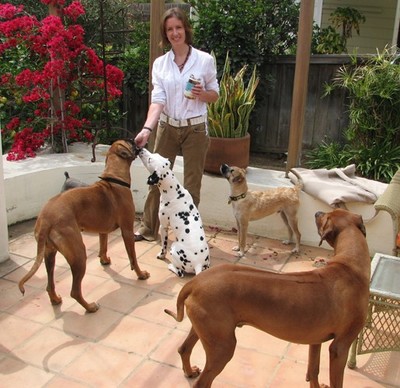
In 2002, Bird Rock resident Lucy Postins founded The Honest Kitchen, which produces a line of dehydrated human-grade raw-food diets for dogs and cats. She thought others would be interested in the raw regimen she had developed for her Rhodesian ridgeback puppy, Mosi.
Her company’s pet food is produced at a Los Angeles-area commercial kitchen that also makes baked goods, cereals and organic prepared foods for human consumption.
Postins, named one of the “Top 25 People to Watch in the Pet Industry in 2006,” sees her company’s mission as much broader than just making healthy pet food.
“We see our role as helping people learn more about how to buy good pet food and have a holistic approach to their animal’s health, including good nutrition, a conservative vaccination schedule, moderate veterinary care and a happy life,” she said.
Now Mosi, along with four other dogs and one cat belonging to staff members, comes to work daily as an “executive” at The Honest Kitchen’s sunny offices in north Pacific Beach. Mosi and his cohorts are in charge of tasting (and eating) his company’s products daily. All have glossy coats, tartar-free teeth and remarkably even dispositions. They appear to thrive on their raw-food diets.
Postins’ business has exploded since the first news of the pet food recall made headlines last month. She is adding a sixth employee to help process orders, which have more than tripled recently. Fifty-two new stores now carry her products, which are available locally at Pet Stop and Dapper Dog in La Jolla, City Dog in the East Village, PetPeople and Whole Foods, as well as Noah’s Ark and Point Loma Pet Pantry.
Postins, who graduated from Moreton-Morrell Agricultural College in England with a degree in business and equine studies, came to San Diego 10 years ago with husband Charlie, a design sculptor for Nissan who doubles as creative director for The Honest Kitchen. Previously, applying her animal and agricultural studies, she worked for Solid Gold, a pet food manufacturer based in El Cajon that she described as “one of the pioneers in holistic pet food.”
Postins sees an array of health benefits from feeding a raw diet, instead of canned food or kibble.
“The raw-food diet is a much more natural way to feed animals and can prolong their lives,” she said. “Cats and dogs are not meant to be grain eaters. They’re obligate carnivores, meant to eat mostly meat.”
She sees a direct correlation between increases in cancer, diabetes, allergies and other illnesses and the post-World War II advent of the commercial pet food industry.
“People’s pets did a lot better on table scraps,” she said, rather than the grain-based, high-carbohydrate diets produced by the commercial pet food industry, which is a heavy user of byproducts, discards from human food production that may include ground-up beaks, feet, feathers and other animal parts not consumed by humans.
“It was only a matter of time until this recall came up,” Postins said, noting other recent tainted pet food recalls.
The Honest Kitchen uses only human-grade meats, produce, and vitamins and minerals in its food, and buys organic produce whenever possible. In order to put “human-grade” on the label, her business had to provide the Food and Drug Administration with affidavits from every supplier and her production facility attesting that everything was fit for human consumption.
“We taste everything we put out. There’s no reason not to. So does the plant that makes it. Every batch is tasted by humans at the factory,” she added.
Liz Heinz, co-owner of Point Loma Pet Pantry, is another raw food advocate. Her family opened a pet food store after adopting a dachshund with severe digestive problems that did poorly on a vet-prescribed diet but “became unbelievably healthy on a raw diet,” she said.
“We don’t carry anything with wheat gluten. Corn, wheat and soy are allergens for pets and not part of their natural diet,” Heinz said. “It’s only added to the pet food to make extra profits for the industry. Cats are carnivores, dogs require lots of protein. The pet food industry added more and more grains because they produce higher profits but they’re indigestible for the pet.”
Pacific Beach resident Tracey Benson converted her pugs to a mostly raw diet after admiring a raw-fed dog’s coat at Dog Beach.
“I thought I’d give it a try. They really like it and are doing really well on it and their coats have improved,” she said.
For information about The Honest Kitchen’s pet food products, visit www.thehonestkitchen.com or call (858) 483-5995. For information about Noah’s Ark Pet Wash & Boutique, visit www.noahsarkpetwash.com or call (858) 270-8161, and for Point Loma Pet Pantry, visit www.pointlomapetpantry.com or call (619) 222-1986.
QuickInfo:
Web-based resources are chock full of information about pet food and the recalls. Here are a few useful Web sites:
“¢ www.petconnection.com ” has good summaries of recent news articles and excellent links to Food and Drug Administration, pet food manufacturers and other news resources.
“¢ www.itchmo.com “” offers guidance on what to feed your dog or cat, excellent forums for discussion of different pet foods and an e-mail pet-food safety alert list.
“¢ www.petfoodexpress.com “”provides a good list of which foods are made by manufacturers involved in recall, including those not affected by the recall.
“¢ www.thepetfoodlist.com “”offers an extensive listing of pet foods, where they’re made if available, and who makes what food. This list is compiled by PetSitUSA.
“¢ www.catinfo.org/index.htm ” lots of useful information about various foods for cats, and how to convert cats from kibble to wet or raw food in an excellent vet-written article.
“¢ www.whole-dog-journal.com “” the Web site of the by-subscription Whole Dog Journal provides dog-specific guidance on feeding, behavior and health issues.
“¢http://petfoodtracker.blogspot.com “” more information about the recall and affected foods.
“¢ www.api4animals.org “” offers an informative and newly updated report called “What’s Really in Pet Food?”
“¢ www.rawfed.com “” an excellent run-down on raw food diets and how to alter pets’ diets.


