


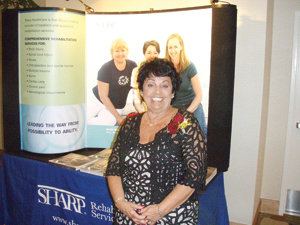
Jo Ann Antigiovanni, a 33-year Pacific Beach resident, was living a full life in 2004: traveling with her husband, tending to her son, volunteering in the community and working as an administrator and agent at a CPA firm. Then, after a particularly hectic tax season, she took a trip to Lake Tahoe, where she struggled the entire time to breathe and, at times, walk. She assumed she was suffering from the effects of work-related stress, but upon returning home and undergoing a battery of tests, her doctors delivered a stunning blow: she was diagnosed with sarcoidosis, pulmonary hypertension and scleroderma, a trio of life-threatening diseases that attack the lungs. The treatment involved a plethora of medications — including steroids — as well as 24-hour use of an oxygen tank. Not only could she barely breathe, but she was also permanently tied to the cumbersome machine that inhibited her mobility, her lifestyle and her self-esteem. While many people in the same situation might respond by retreating from the public, Antigiovanni became even more determined to live life on her terms. “When you go on oxygen, the first thing you want to do is stay at home and never be seen,” Antigiovanni said. “You have to decide what you are going to do. My decision was, ‘I’ve got to do something about this. I can’t spend the rest of my life at home.’” On June 4, Antigiovanni was recognized for her fighting spirit at the Sharp HealthCare Foundation’s 2010 Victories of Spirit awards gala, which honors former patients who “embody the spirit of courage, strength and possibility,” according to David Brown, Sharp’s system director of rehabilitation services. Antigiovanni began receiving treatment through the Sharp pulmonary rehabilitation program and steadily regained strength. As her health improved, her involvement increased, and she became the “Pulmonary Rehab Greeter” to help encourage her fellow rehab patients to become active again. She also aligned herself with the American Lung Association (ALA), and in 2008 she completed the “5K Healthy Air Walk” with her oxygen tank in tow. Antigiovanni said she hopes her participation in that event, as well as her subsequent role as an ALA spokeswoman, will encourage other people on oxygen to start living their lives again. “If I can get one person out of their house and into [Sharp’s pulmonary rehabilitation] program and walking and feeling like they can do something for themselves, I feel like I’ve made a difference,” Antigiovanni said. “I would like them to see they can do this,” she said. “They don’t have to sit at home. A very difficult thing for me was going to the movies, because you’re on oxygen and you hear these little poof, poofs, and you think, “Am I bothering other people or something?’ People on oxygen, they have to go to the movies. They have to do other things. They can’t just stay home.” Antigiovanni’s health has improved so much that she is now uses oxygen only on an as-needed basis. Her next challenge is a summer trip to Sedona, Ariz., which has an altitude of 4,500 feet — about 2,000 feet higher than the elevation at which she stops being able to breath completely — where she said she is excited to test her new portable oxygen concentrator.


