


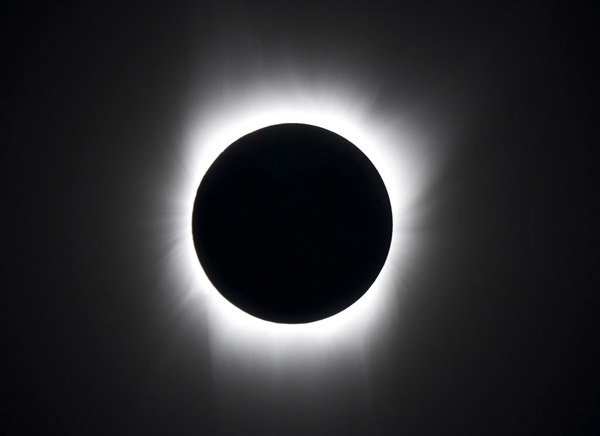
A total solar eclipse will occur the morning of Monday, Aug. 21, and San Diegans will be ready for it. But unfortunately, in Southern California the eclipse will not be “total.”
“San Diego will only be getting a partial — 57 percent obscured — solar eclipse starting at 9:07 a.m. and reach maximum at 10:23 a.m.,” said Lisa M. Will. Ph.D, professor, Astronomy/Physics Department chair, Physical Sciences at San Diego City College, who is also a Reuben H. Fleet Space Theater lecturer. “That’s still a pretty good eclipse of the sun.”
This will be the first total solar eclipse in the continental U.S. in 38 years. The next solar eclipse visible in San Diego will not occur until 2023.
Some local places where there would be an unobstructed view of the eclipse are Mount Soledad and Cabrillo National Monument. The Reuben H. Fleet Center in Balboa Park and city public libraries will be selling/providing eclipse glasses.
“Your eyes can suffer permanent retinal damage if you look directly at it,” cautioned Will, adding, “Just look away. Sunglasses aren’t good enough. They don’t block out enough of the light.”
The astronomer noted that, whatever glasses you use to protect your eyes when viewing the eclipse, “if you look through your glasses at a regular household lamp, and light is still getting through — it’s not good enough.”
The path across North America, where the moon will completely cover the sun and the sun’s tenuous atmosphere, the corona, can be seen, will stretch from Lincoln Beach, Ore. to Charleston, S.C. Observers outside this path will still see a partial solar eclipse. The thin path of totality will pass through portions of 14 U.S. states.
Will noted solar eclipses aren’t all that rare. “They happen once every 18 months or so,” she said, but added that total solar eclipses, are indeed rare.
“The last time we had a total solar eclipse visit us in the United States was in 1991, and that was only viewable from Hawaii,” Will said.
Will noted that two things are needed for a total solar eclipse. “A new moon, and the sun, moon and Earth have to be exactly aligned with each other,” she said, adding the moon is “actually tilted about 5 degrees from Earth’s path around the sun, and doesn’t actually line up with the sun every month.”
More information on the Fleet’s solar eclipse viewing event can be found at www.fleetscience.org. Solar eclipse
When: Monday, Aug. 21, from 9:07 to 10:23 a.m.
Viewing: Megacast on Reuben H. Fleet Dome in Balboa Park until 1:15 p.m.


