


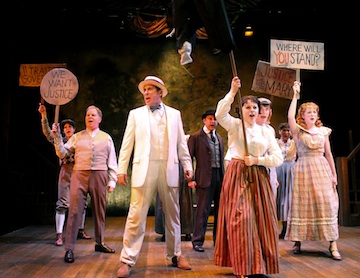
“Parade”

Through April 29
Cygnet Theatre
Wed & Thurs 7:30 p.m.
Fri 8 p.m.
Sat 3 & 8 p.m.
Sun 2 & 7 p.m.
619-337-1525
cygnettheatre.com
Cygnet’s musical a poignant look at race and bigotry
By Cuauhtémoc Kish | Downtown News
There is not much parade watching going on in Cygnet Theatre’s latest, “Parade,” playing through April 29 at their theater in Old Town, but that is expected considering Alfred Uhry wrote the book about a very painful chapter in American history.
Although it garnered accolades and a few Tony Awards when this rather dark musical opened in 1998, it never truly found an audience. In 2007, the show was reintroduced with a much smaller cast and orchestra, and this latest rebirth seems to have found a solid, devoted fan-base all its own.
The story focuses on Leo Frank, a transplanted New York Jewish man who moved to the South after wedding a Georgia peach named Lucille. Leo, the hard-working boss of a pencil factory, is accused of raping and murdering a thirteen-year-old worker named Mary Phagan. The rather somber musical plays out Leo’s 1913 trial and its aftermath, and speaks non-apologetically about racism, bigotry and the mob mentality. It also chronicles a love story between the two lead roles.
Jason Robert Brown’s music and lyrics are solemn, dark and energetic, and have the ability to make the audience think about the consequences for actions. The lyrics also raise the question of Leo’s innocence, but never quite answer it.
Director Sean Murray’s cast of sixteen works hard and captures the spirit of the South, with most actors handling multiple roles. Murray’s superb staging makes everyone look especially good, even when races are pitted against each other and venality is raised.
After the prologue paints a beautiful picture of Georgia, with “The Old Red Hills of Home,” audiences meet Leo as he sings, “How Can I Call This Home?,” where he laments the fact that he has left the city for the South. The song underscores the character’s emotional isolation from not only his Jewish community but also from his wife, who still thrills to celebrate “Confederate Memorial Day.” It seems there is always talk of a parade passing by in this production.
Sandy Campbell plays Lucille with tenderness; making us believe in the love she has for her overly principled husband. Campbell hits all the right notes, musical and otherwise, especially in “You Don’t Know This Man.” For his part, Brandon Joel Maier as Leo is a perfect stoic, balancing cold, scornful and dignified at one and the same time. Their duet, “All The Wasted Time,” will tug at your heartstrings.
The other cast members managed ensemble and individual numbers with bravado. Standouts include Bryan Barbarin, who belts out gospel notes while taking on the roles of Newt Lee, Jim Conley and Riley; Jacob Caltrider, who plays multiple roles including Frankie Epps; and Rick Meads, who plays Governor Slaton. David Kirk Grant and Steve Gunderson make nice music throughout the show, but especially on their fishing duet, “The Glory.”
Sean Fanning’s set design was mostly bare, allowing the large cast to strut their stuff unimpeded, all under the large canvass of a giant old tree. Shirley Pierson’s period costumes were appropriately dark and subdued. David Brannen made many a magic turn as choreographer, especially in the number “The Picture Show.”
The seven-member musical ensemble, led by Billy Thompson, mastered the challenging score.
Although “Parade” is no jukebox musical with the standard forever-smiling faces, it is good to be reminded of history, even when painful.


