


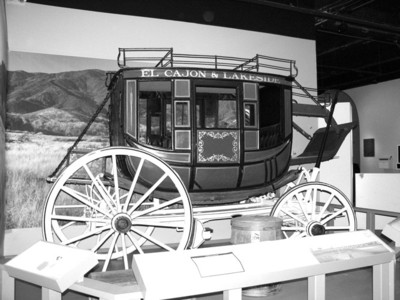
Step into the lobby of the San Diego Historical Society (SDHS)’s Museum of San Diego History in Balboa Park, and the first thing to be noticed is the towering red Concord stagecoach with the giant yellow wheels.
Built in New Hampshire in 1866 originally for a New York hotelier, the coach first came to San Diego in 1886 to provide passenger and mail service for the Frary and Foster stage line, connecting the rural communities of El Cajon, Lakeside and Julian. Later, in 1913, Elisha Babcock, builder of the Hotel del Coronado, purchased it for use in San Diego at his Diamond Carriage and Livery, displaying it at the 1915 Exposition in Balboa Park.
Now the elegantly restored stagecoach, which was donated to SDHS in 1930 and for decades sat outside what is now the Serra Museum, has a new role to play as an “icon artifact,” a key object used to evoke an era in San Diego’s history. It is now shown before a wall-size modern photograph of the backcountry it once served. Visitors will again be able to view the stagecoach, recently off-exhibit, when the second phase of the museum’s new permanent exhibition, entitled “One Place, Many Cultures,” opens on July 19.
The stagecoach’s prominent visibility was a key element in designing this aspect of the exhibition, explained David Krimmel, SDHS’s associate director and director of exhibits, who designed the space around the icon artifacts.
“A big concern was getting the sightlines set up so you can see the stagecoach right away, so that you always have connections forward and backward in time.
Standing in one place you will be able to see icon artifacts of different generations, so that [visitors] aren’t locked into one period of time and can see the transitions,” he said.
In July 2006, SDHS opened the first phase of the new permanent exhibition, which was more than 30 years in development, explained senior curator Nicholas Vega. “One of the reasons for moving into this building was installing this exhibit,” Vega said.
Setting the stage for the three artifact-filled exhibition phases to follow, the first room lays out San Diego County’s geography through a large map covering the floor, inviting guests to discover and explore the county’s varied terrain.
The county’s landscape is revealed through wall-size Depression-era Works Progress Administration (WPA) murals by San Diego landscape artist Charles Reiffel, complemented by Indian-themed WPA-commissioned paintings by San Diego artist and teacher Belle Baranceanu.
The newest installation covers over 12,000 years, Vega explained, from the earliest Kumeyaay habitation, through the Spanish, Mexican and early American settler eras, ending about 1885.
All of the photographs, art and artifacts are drawn from the society’s existing collections, although some modern photographs of regional landscapes were commissioned as backdrops for this exhibition, he said.
Because they have so much time and material to cover, museum staff chose representative objects “” the icon artifacts “” as tools to tell the region’s story.
“We’re using items to represent the figures of the time,” Vega said.
For example, everyday objects made from local natural resources, such as a hide rattle, clay cooking pot and shell fishing hook, convey the Kumeyaay story.
The Mexican era is told through family photographs displayed alongside a red-and-white hand-appliquéd quilt made by Juana Machado, matriarch of the prominent Old Town Mexican family. Alonzo Horton’s role in the development of New Town San Diego is conveyed through an ornamented mirror, sign and weathervane, all of which survive from the 19th-century Horton House Hotel, site of the current U.S. Grant Hotel.
A 19th-century ore cart, similar to one used in the San Diego backcountry, evokes the mining era.
“One of the things we wanted to do was highlight what we have in the collection,” Vega said.
While the exhibition is described as “permanent,” it was designed with flexibility in mind so that objects on display can be rotated and the storyboards easily changed and temporary exhibits added or removed.
“We rotate our costumes and textiles about every six to eight months,” Vega explained, because extended exposure to light damages fabrics. The Machado quilt is displayed in a specially constructed gallery with subdued sensored lighting.
People’s stories and perceptions of objects also vary with time and experience. “If you put a beer can in front of frat boys, their story will be very different from that of women who live with alcoholics,” said exhibit designer Krimmel.
Interwoven into the exhibit are interactive features for children. Children can learn about natural resources by touching objects such as the Kumeyaay would have used and can dress up in reproductions of 19th-century clothing.
Bum the dog, an authentic 19th-century character, also offers historical vignettes geared to young children and families.
Visitors can also order prints of photographs on display or from SDHS’s photographic archive of over 2.5 million images of the region.
The new exhibition opens on Thursday, July 19 at the Museum of San Diego History in the Casa de Balboa at 1649 El Prado, Balboa Park. The museum is open daily from 10 a.m. to 5 p.m.
Admission is $5 for adults with reduced rates for children, seniors and military and free for members. For more information, visit their website at www.sandiegohistory.org or call 619-232-6203.


