


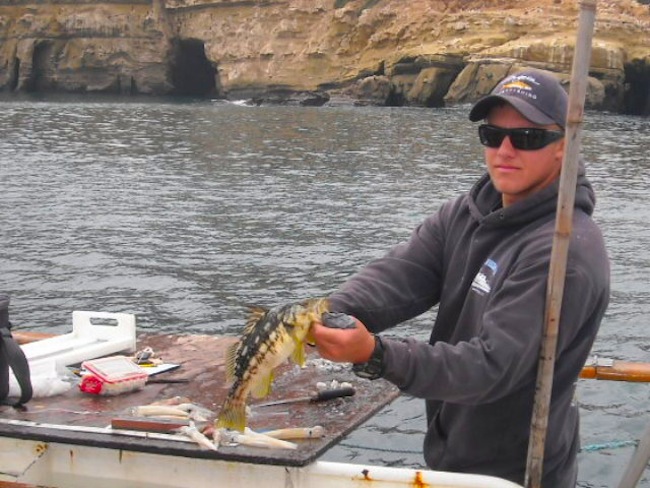
Scripps scientist sets out to study local fish
Will Bowen | Downtown News
A number of local citizens, including kayakers and swimmers, were very concerned recently to see the Sea Watch, a sport fishing boat from the Seaforth Landing, fishing in the 40-year-old marine preserve that surrounds La Jolla Cove.
One advocate even took video footage of the boat’s activities and sent numerous emails to news agencies and government authorities claiming it was disturbing the seals and sea lions.

As it turns out, the Sea Watch, which had all the necessary permits, was on a Scripps Institute of Oceanography (SIO)-sponsored scientific mission to gather data about local fish populations so as to better inform the California Department of Fish and Wildlife in their management of our local marine reserves.
“A lot of people thought that we should not be fishing in the Cove,” said Lyall Bellquist, a SIO graduate student who is heading up the project that brought the Sea Watch to the Cove. “But we need information on the fish populations, both inside the preserves and outside in the open areas, so that we can compare them and see how the preserves are working.”
Bellquist was thankful for the advocates that showed their concern by taking action.
“It shows that local people, and not just the authorities, can help police these reserves so as to protect them,” he said.
Working under the supervision of Dr. Brice Semmons at SIO, Bellquist received a two-year $240,000 grant from Collaborative Fisheries Research West to study the fish species known as Paralabrax—also known as kelp bass and includes calico, sand, and spotted bay bass—the keystone of our recreational fisheries. Bellquist is trying to determine their growth and movement patterns and to learn the status and health of their populations.

What makes this project unique is that the scientists involved are working hand-in-hand with fishermen, instead of being caught up in the usual war between environmentalists and sportsmen. Local fishermen are invited to come and catch fish for free on sport fishing boats. The fish are then all tagged, measured and released. With the fishermen, the sport boaters and the scientists all happy, it’s a win-win situation for all.
Bellquist has run 40 small boat fishing trips so far, tagging bass all the way from Imperial Beach up to Oceanside, including San Diego and Mission Bay. He has also begun working with the Mexican government to acquire the necessary permits to tag fish in Mexico, so as to study fish movement across international waters.
After a bass is caught, Bellquist inserts a small white numbered tag into the dorsal area of the fish and then the fish are released back into the water. The process is painless and does not interfere with the fish’s activities and studies have shown that almost all of them survive the tagging process.
When a fish is re-caught, the fisherman involved is requested to call a phone number on the tag and report the date and place of capture. As an incentive, the caller is then entered into a monthly raffle for a $200 gas card.
“So far we have tagged about 7,000 calico bass and 2,000 sand and spotted bay bass,” Bellquist said, adding that the recapture rate is approximately nine percent for the calicos and four percent for the sand and spotted bays. He said this data suggests that most of the fish stay within a 500-yard range of where they were initially caught, although one calico bass did swim all the way from La Jolla to the San Clemente Pier.
“I would say that we have a very large population of calico bass in our local kelp forests at this time,” Bellquist said.
It was originally believed that the species generally moved from bay to bay, but these studies so far do not support this idea. Bellquist and his colleagues said they are concerned about the sand bass population, which are often hit hard during their spawning seasons by fishermen off of Imperial Beach and the Coronado Islands.
Sea Watch skipper Kris Karpow, who worked his way up from deckhand to become pilot of his own boat nine years ago, has led eight of the 40 tagging trips, and hopes the project helps the sport fishing industry.
“There are a lot of captains, boat owners, and crew who make their livelihood in fishing and they are worried about it being shut down and losing their jobs,” Karpow said.
Bellquist is quite happy to be a part of a program where fishermen and scientists work together and with the intention to help government make the best decisions regarding the local marine reserves.
“I hope people will understand our research and our need to fish in places like La Jolla Cove, because it will help ensure the long term health of the marine ecosystem,” Bellquist said . “We want our grandchildren to be able to enjoy our bays, the coast, the kelp beds, and the fisheries as much as we do.”
Bellquist invites all concerned fishermen to sign up for a free tagging trip or follow the progress of the research on the website cooperativefishtagging.org or on Facebook at “Coastal Angler Tagging Cooperative.”
Will Bowen writes about arts and culture. You can reach him at [email protected].


