


To hear the San Diego Historical Society tell it, 1915 was this city’s most notable year of the 20th century. It did amount to a pretty good time, what with the opening of the fabled Panama-California Exposition and all “” but little could this region have foreseen the specter of so dire an era at home and abroad. U.S. involvement in World War I was just around the corner. The Great Depression, a second global conflict, assassinations of this country’s figureheads and thousands of meaningless deaths in a Southeast Asian civil war were to propel the nation toward a series of conspicuous fates. Milli Vanilli would grace modern American music with its grisly presence in a mere 75 years.
The point is that 1915, and 1918, 1929, 1941 and 1963, were watersheds in their own rights. In each case, the future and the present were interchangeable amid man’s incapacity to predict. That’s sort of the idea behind the new downtown Museum of Contemporary Art San Diego, which will open to the public on Jan. 21. Like the future, this genre of art defies characterization “” the present makes short work of any attempt.
Part of the difficulty, museum curator Stephanie Hanor explained, stems from the wholesale blurring of distinctions between media as they constitute a work of art. Photography, film, music, theater, dance, the spoken word, refinements of traditional forms: All seem to share an ever-widening spotlight as patrons clamor for spectacle-driven pieces.
“I think that’s one of the things that makes the museum experience exciting,” Hanor said. “There’s no way to easily categorize or define what contemporary art is. It really is the art of our time. And right now, that’s a very open-ended thing. It’s a really open slate as to what constitutes art in the first place, much less what constitutes contemporary art.”
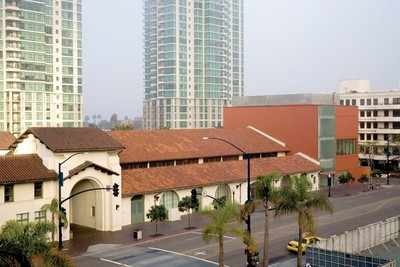
The space, which will add 30,000 square feet to the museum’s existing galleries in La Jolla and the downtown, reflects these changing times. The flagship La Jolla gallery, which opened in 1941, features a stately cast to its spaces and lends itself to more sedate presentations. The new building exploits a different architecture altogether “” a style that ironically derives from 1915’s Panama-California Exhibition. Part of the new campus was culled from the Santa Fe train depot baggage area, which opened that year.
The venue, Hanor said, is “very much how it was built when the train station first opened. It was pretty cutting-edge engineering usage to create that space. They’re big spaces without central columns, all held with these steel beam structures, so there’s all sorts of natural light that comes through there. It’s a very open space, which means we can… focus on a type of contemporary art which is becoming more prevalent.” Such exhibits, she said, include large-scale installations with video and performance embellishments — “the kind of exhibitions that we really couldn’t do in our other spaces.”
Work was begun on the baggage building in 2004, with architects Richard Gluckman and Milford Wayne Donaldson working to preserve or re-create the brick and stucco exterior, hand-formed Spanish clay roof tiles and 16-inch globe light fixtures. The wooden storefront façade has been refurbished with glass and abuts a new three-story structure, new outdoor exhibit locations and an artist-in-residence studio.
The campus features commissions by Roman de Salvo, Jenny Holzer and Richard Serra, new works by Ernesto Neto and Richard Wright and an installation by Eija-Liisa Ahtila. In a nod to contemporary art’s multimedia wave, Ahtila’s installment is shown in four simultaneous projections, with the story edited to unfold on four screens. It’s called “The Hour of Prayer” and centers on the artist’s grief surrounding the death of a dog. The action takes place over 11 months and is set in locations from New York to Benin, West Africa. “The Hour of Prayer” will be on view through May.
That approach is a long way from 1915, which was about 40 years removed from the foundations of digital media and decades behind the 1993 opening of the museum’s original downtown venue, located at 1001 Kettner Blvd. Then again, contemporary art defies comparison as never before “” which likely means the new building’s innovators haven’t missed a step.
The Jan. 21 event runs from noon to 6 p.m. at the museum’s 1100 Kettner Blvd. location. Admission is free. Further information is available at (858) 454-3541.


