


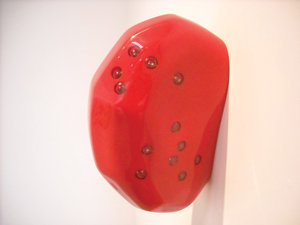
The Scott White Contemporary Art Gallery is located at 939 Kalmia St. at the north end of Little Italy. It is an austere, polished and technical-looking, gray building covered with numerous small stainless steel panels which are bolted to the facade. According the gallery assistant, Haley Crone, the idea behind the lack of external “fancy frills” is to help “cleanse the visual palette” to make for better viewing of the art inside. The interior of the gallery space is a large, high-ceiling, L-shaped room with wooden rafters, a cement floor and white walls. There is an elevating door large enough for a car to drive through, lots of empty space and a “newness” or “just built” feeling, as if the construction cleanup crew had just left. This could be a motorcar showroom for Maserati or Ferrari, and, indeed, this is the class and caliber of the art that White, who has been in the modern art business for 30 years, likes to show. White sells modern art that exemplifies taste, class and distinction; and whose ownership conveys the idea of “cultural capital.” On view now and continuing until Nov. 6 at Scott White is a show called “New School Cool,” which features the paintings of DeWain Valentine and the sculptures of Eric Johnson. This show is the update of an art movement which began in the 1960s called variously “Light & Space,” “Finish Fetish” or “Cool School,” exemplified by artists such as Robert Irwin, Craig Kauffman, James Turrell and Valentine, with Eric Johnson joining later in the 1970s. This movement was characterized by a focus on perception, vision, and illusion, and made use of modern, industrial, often highly-toxic materials such as acrylic, resin and lacquers, which were used to create impeccably-flawless, glossy surfaces of bright colors. The materials were borrowed from the industries that helped create the Southern California culture of polished classic cars, hot rods and surfboards. Now, 50 years later, Valentine and Johnson have joined forces to showcase the progression of this movement and take it into the 21st century. Valentine, who said he is “fascinated with transparency, reflection and light,” has five paintings in the exhibit, with titles such as “Vertical Skyline 001,” “006,” and “007.” They are 6-foot-by-4-foot, made of acrylic 3-inches-thick, and sprayed with acrylic auto paint. Each has a slit in the middle to allow light to pass behind the painting, which helps to create some unique visual effects. The coloration is a subtle whitish translucence with a pinkish tint or hue around the edges. These are very subtle works, with their prime value in the way light plays on them. They could be thought of as a slice of the sky or the sunset in the whiteness of the Antarctic. As Valentine said, “I have always wished I had a magic tool to cut sections out of the sky and seas.” Johnson, who claims to “use a full array of auto tools and pigments,” has nine sculptures in the exhibit. Three look like large DNA strands, two like twisted and swollen power boat propellers and three like giant, colorful corn kernels. Each is composed of resin (sometimes with added materials) and has a rich color and a glossy surface. Johnson’s ninth sculpture, which is the centerpiece of the entire show, is a 12 1/2-foot-high black DNA strand attached to a circular base made of resin and polyester, with the name “Pinkie of Bob,” which is a humorous reference to fellow artist Robert Irwin. Gallery hours are Tuesdays through Saturdays, 9 a.m. to 5 p.m. For further information see scottwhiteart.com or call (819) 501-5689.


