


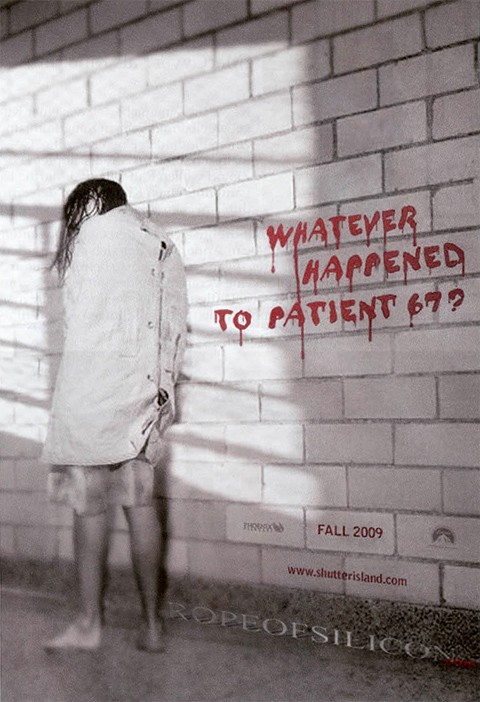
“Shutter Island”
Directed by Martin Scorsese
Written by Laeta Kalogridis from a novel by Dennis Lehane
Starring: Leonardo DiCaprio, Mark Ruffalo, Ben Kingsley, Michelle Williams and Max von Sydow
Rating: 4 out of 5 stars
By Scott Marks
SDUN Film Critic
 You have had two weeks to visit your local multiplex to pay tribute to Marty. If you haven’t seen “Shutter Island” at least once by now, you’re not my kind of reader. The following is intended solely for the enlightened. There are many, many spoilers ahead.
Most directors start their career with genre pictures as Marty did with the ultra-low budget, Roger Corman-school “Boxcar Bertha.” After screening the picture for mentor John Cassavetes, the Hollywood maverick looked into Marty’s soul, told him that he just wasted a year of his life and asked, “Don’t you have something of your own that you want to do?”
That something became “Mean Streets.” For nearly three decades, Scorsese has followed Cassavetes’ advice to the letter, give or take “Cape Fear” and a certain Oscar winner. During the press junket for “Gangs of New York,” Scorsese announced, “I’ve made all the pictures that I originally set out to make.” Over the years, Marty has told numerous interviewers that he wanted to be a Hollywood genre director, but his temperament led him down a road less followed.
After “Gangs” he has finally gotten around to giving us his take on traditional genre pictures. “The Aviator” is an efficient, straightforward Hollywood biopic that uses new technology to tell an old story. “The Departed” is an old fashioned Sidney Lumet cop picture/Academy guilt trip. Even better than both of them combined, “Shutter Island” is Marty’s Hitchcock thriller with equal doses of Sam Fuller and Val Lewton thrown in to fill out a satisfying Sunday matinee.
The idea had been growing in Marty’s head for quite some time. During the preparation of “Shutter Island,” Scorsese produced and narrated “Val Lewton: The Man in the Shadows,” a documentary about the revered 1940’s “B” noir horror producer. “Bedlam,” the last picture in Lewton’s nine noir cycle at RKO, takes place in London’s legendary insane asylum. The original title of Scorsese’s film (“Ashecliffe”) indicated that it might be patterned after the Lewton classic.
With its cramped, dankly lit interiors, much of the look of Scorsese’s fever dream can be traced back to Lewton. At its thematic core the film owes more to Hitchcock’s deeply personal self-portrait, “Vertigo,” and Sam Fuller’s “Shock Corridor.” (In the latter, a newspaper reporter checks into a mental hospital to solve a story and winds up more insane than any of its inhabitants.)
There is nothing quite so much fun as the act of being fooled. Marty hoodwinked me 110 percent of the way. I should have caught on the second I saw the digital recreations of 50s matte shots during Teddy Daniels (Leonardo DiCaprio) and Chuck Aule’s (Mark Ruffalo) boat trip to the island. The stylistic application of intentional artifice should have been an instant tip-off that what we were looking at wasn’t meant to be believed. There was also something not right about Chuck’s over-familiar use of “boss” each time he addressed his new partner. And after the tenth time, Teddy’s forceful boasts that he’s a U.S. Marshal begin to sound like he is trying to convince himself of the fact.
Teddy hits shore already agitated and feeling overly aggressive. He came to the right place. “Shutter Island” houses an elite group of America’s most dangerous and damaged patients perfectly distilled in a 1954 microcosm that also reflects current societal fears.
All of the film’s establishing shots are perfectly balanced and composed, but the music signals that this will soon change. An aerial shot on the island, a skillful homage to “Night of the Hunter,” immediately pulls us into the action. Teddy and Chuck are there to investigate the disappearance of female patient Rachel 1 (Emily Mortimer) who murdered her three children. As the crime drama unfolds we are treated to a series of flashbacks revealing Teddy’s backstory concerning his late wife Dolores (Michelle Williams) and his military experience liberating Dachau.
The basic narrative is as straight-forward as anything the man has directed and there is very little in the way of visual panache. “Shutter Island” doesn’t jump at you like some of his other films. It slowly draws in the viewer without once tipping its hand. As always, it’s his command of the medium that makes it all so fascinating.
In “Bedlam,” Lewton stocks his asylum with what amounts to the forefather of motion pictures. (The character invented the flip-book.) In Marty’s self-reflexive madhouse he cast Elias Koteas as a villain from Teddy’s past. He is given 60 seconds to execute a fireside transformation from Travis Bickle into Max Cady. Koteas’ conversion is not the real thing, but an amazing simulation.
The women in a Scorsese picture usually draw little more than a beating. Dolores’ flowery summer dress soon becomes a blood splattered shroud. She’s shot, soiled and incinerated, yet her existence overshadows the entire proceeding. Not unlike Jimmy Conway in “Goodfellas,” her time onscreen doesn’t amount to much, but her presence is felt in every frame. In what could be Marty’s most erotic onscreen moment to date, she straddles her husband and teases him to put a bullet in her.
As the plot unravels, Teddy finds Rachel 2 (Patricia Clarkson) hiding out in a cave. She listens to all of his questions and her answers are worse than anything he feared. The head doctors are former OSS and the island project is funded by an HUAC doctors’ experiment on patients with psychotropic drugs in hopes of creating a generation of Manchurian candidates.
In the film’s best line of dialog, Rachel 2, now cast a psychiatrist, predicts, “In fifty years they’re going to trace it all back to here.” Novelist Dennis Lehane uses the not-so-distant past as a metaphor for contemporary paranoia. Having never read one of his novels, my only familiarity with the author is another horrific tragedy, Clint Eastwood’s adaptation of “Mystic River.” This guy’s work features more dead kids than a Nancy Grace marathon.
When it’s over, “Shutter Island” could amount to Marty’s most cruel feature. I never once felt pity for the Goodfellas or Jake LaMotta and the ironic twist at the end of “Taxi Driver” added more fun to match the horror. If “Taxi Driver” is a story about a man making himself sane, “Shutter Island” is its mirror opposite. Structurally it’s closest in line to “After Hours,” another journey through an Emerald City gone bad. (It’s always been my contention that “After Hours” is Marty’s negative image of “The Wizard of Oz.”) In each case the protagonist comes face to face with his or her true madness in order to find redemption. But you can’t really classify “Shutter Island” as a descent into madness. Upon his arrival, Teddy had already been a mental patient for two years.
It wasn’t until Kingsley, The Wonderful Wizard of Ashecliffe, asks, “Baby, why are you all wet?” that it began to congeal. Sir Ben is left with the unenviable task of breaking poor Teddy’s spell. He does it by forcing him to accept reality: There is no place like home. Unfortunately, and this is the true tragedy of the film, when we discover Teddy’s real home life it’s much worse than anything he encountered inside the halls of Ashecliffe.u


