


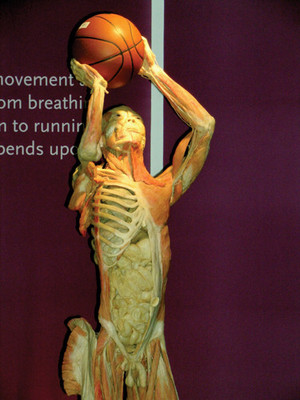
Some people will think it’s gross, others will think it’s cool. Some may even find it a bit disturbing, while others will be fascinated. “Bodies…The Exhibition” opened May 12 at the Westfield UTC shopping center, featuring real human bodies on display to reveal the inner workings of a human being.
“We want people, when they leave here, to be better educated about their own bodies: to understand them better, and hopefully care for them better,” said Dr. Roy Glover, chief medical advisor for the exhibit.
The donated bodies were preserved through an innovative process that replaces the water in the body with a silicone polymer mixture, resulting in rubberized tissue that still looks like the original tissue but is permanently preserved. Using different methods of dissection and extraction, the exhibit creators isolated and displayed all of the body’s organs, blood vessels, muscles and other tidbits.
The journey into the body begins with the skeletal system. The various displays reveal the different types of bones found in the body and how they work together to provide support for muscles and organs.
Visitors are next treated to the muscular system.
“Most people don’t realize that the muscular system is such a beautiful part of the body,” Glover said. “Muscles give form to our bodies and help to move us.”
The specimens are presented in a way that highlights how every single movement and function of the body relies on groups of muscles precisely coordinated to operate as a single system.
The mysterious nervous system follows. Despite advancements in medicine, scientists are still unsure exactly how the nervous system is able to execute decisions and responses faster than the most powerful computers built by humans.
Visitors can view many structures in the brain, from the cerebellum, which enables us to balance on one foot, to the pea-sized pituitary gland, the master regulator of the hormones that course through our blood, controlling growth, blood pressure, metabolism, sexual drive and many other processes.
The journey then progresses to the circulatory system. Against a black background, the vibrant, glowing red networks of blood vessels in the shape of organs and limbs appear to hover eerily in the air.
Respiration, the process through which the lungs extract oxygen from the air, is explained in the next section. Visitors can view the intricate mess of tiny blood vessels, known as capillaries, in the lungs where the blood gets rid of carbon dioxide and takes up oxygen.
A set of healthy lungs juxtaposed with a set of black, tar-filled lungs from a longtime smoker provides a vivid demonstration of the damage smoking causes to lungs.
Digestion, the equally important process of extracting energy from food, is the topic of the following section. Visitors will be amazed at the length of the digestive tract, including the stomach and small and large intestines, and how it is able to fit inside the abdomen. An artery hardened by atherosclerosis, the build-up of fatty deposits inside arteries caused by excess fat in the diet, provides a compelling reason for viewers to maintain a healthful diet.
The next stop on the tour is the reproductive system. Here, visitors can view the inside and outside of male and female genitalia.
Due to its sensitive nature, the next section, featuring human development from an embryo to an infant, is optional; visitors may bypass it and move on to the next section.
Inside, several stages of development are shown, from a chickpea-size embryo already showing the head, arms and legs to an 8-week-old embryo, with all its internal organs fully developed. When development goes wrong, the effects are tragic, which is clearly demonstrated by the preserved fetuses with birth defects.
The final installment promotes the treated body, how medicine impacts our lives and wellbeing. Visitors can view an example of metal implants used to stabilize broken bones, as well as artificial joints used to replace aging joints.
A serial collection of cross-sections of the body demonstrates what doctors see inside the body during an MRI scan. In addition, visitors can pick up samples of a human brain and liver, to experience first-hand the texture of these preserved tissues.
Throughout the exhibition, interesting and useful factoids are presented, such as: each pack of cigarettes reduces your lifespan by an average of two hours and 20 minutes; every drop of blood passes through the heart at least once a minute; and eating breakfast improves your memory for the entire day.
Between the displays and written information, Glover hopes visitors will realize that the human body is more complex and wonderful than anything built by human hands.
Ideally, with this renewed respect for the human body, people will make better decisions in life, since a large fraction of health problems are caused by factors within our control.
“Bodies…The Exhibition” is scheduled to run until Sept. 9, inside the former Robinsons-May building at Westfield UTC, 4545 La Jolla Village Drive.
For more information and to buy tickets, visit www.bodiestickets.com.


