


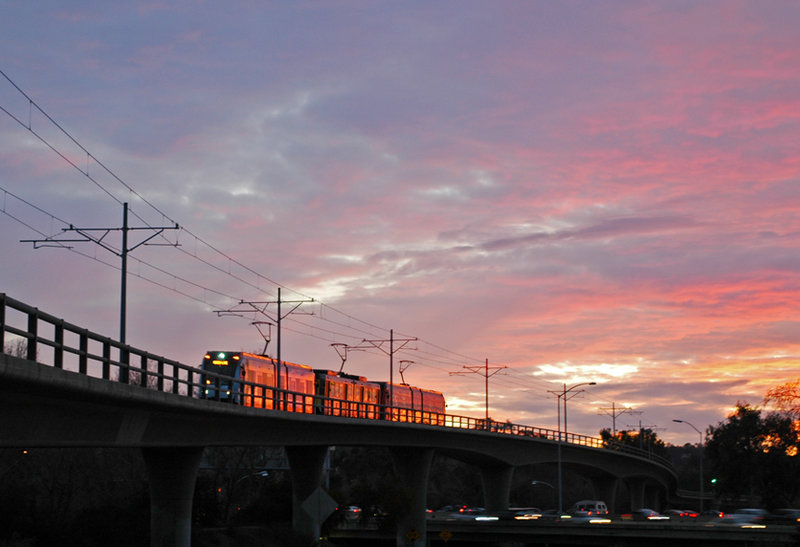
Though years away – if it ever does materialize – the prospect of linking the new Mid-Coast Trolley station planned for Balboa/Morena serving Pacific Beach/Clairemont with light-rail beach service is already controversial.
A public meeting planned prior to the next Pacific Beach Planning Group meeting, scheduled on Oct. 28 to discuss SANDAG’s beach line transit study, has been cancelled and will be rescheduled.
But the debate has already begun amongst community planners, and their regional counterparts at SANDAG, the region’s transportation planning agency, over the feasibility of using light-rail, or other alternatives, to enhance beach transportation infrastructure.
The Mid-Coast Trolley project will extend trolley service 11 miles from Sante Fe Depot downtown to University City, serving major activity centers with nine trolley stops along the way, including two at Clairemont Drive and Balboa Avenue. Construction, costing approximately $2 billion, is expected to begin in 2016 and be completed in 2019. The trolley extension has been designed to provide a viable alternative to highway congestion.
Charles (Muggs) Stoll, director of land use and transportation planning for SANDAG, said discussion of using light rail or other alternatives to create an interlocking network of transportation modes for those coming to the beach in the future is still in its “infancy.”
“We have an extension of the trolley in the plan from the Morena Station with the Mid-Coast project going through PB, which is about to get under construction,” said Stoll. “At this point, it’s very conceptual, basically a line on the map to extend a trolley line from the future Morena Station out to PB then take it further back to the east towards Kearny Mesa, ultimately linking with the Green Line Trolley.”
Stoll said the ultimate objective is to “give people more transportation choices, anything we can do to get people out of driving alone in their cars, giving them more viable options.”
Stoll said there’s also been discussion of the feasibility of using more future-oriented, cutting-edge transportation alternatives.
“As part of this (transportation) study, we’re also looking at things like ‘driverless’ mass transit as well as considering a skyway vehicle that runs on cables. There are places in the world where this technology has been used and can operate at a very high level.”
Greater public vetting of future transportation alternatives has been greeted with mixed reaction by local planners, like Chris Olson and Henish Pulickal of the Pacific Beach Planning Group.
“It is thrilling to see that our city and regional planners are listening to our call to plan improvements along our oceanfront and connect our beach area to the Mid-Coast Trolley,” said Olson. “The method of getting people in and out of PB will certainly be multi-modal. The emerging technology that will clearly change the way we think about getting around is autonomous vehicles, whether they be shared or owned.”
Olson noted he’s “unsure how to predict how this technology is going to evolve,” but he added, “If you think about it compared to our current transportation methods, there will be less of a need for parking spaces and traffic lanes.” He pointed out that “one section of 1-15 has 18 lanes, and some people are asking for more. I think it is time to change our strategy.”
Pulickal, vice chair of the planning group, cautioned that viable future transportation alternatives need to be carefully considered, pointing out light rail, with its comparatively high cost, might not be the best option.
“Self-driving cars and automated trains could be in the future,” Pulickal said, noting, “I’m strongly against long-term plans with rail as a proposed solution.”
The community planner added he’s “strongly considering forming a citizen group to strengthen support on this issue,” pointing out, “Anytime I talk to someone about this issue, they are easily persuaded by the strength of the evidence and logic associated with supporting driverless cars instead of train lines.”
Pulickal believes that “driverless cars are the most exciting transportation tech coming out in the next few years.” He pointed out that “car sharing users have already reduced car ownership by nearly 50 percent across 20 metro areas in the United States and Canada. These same car sharing companies (such as car2go) and car companies (Tesla and all major manufacturers) are investing billions in driverless technology.”
Pulickal said transportation planning needs to be forward-thinking. “What will reduced car ownership and reduced traffic do to our current traffic and parking concerns?” he asked. “What will happen to parking lots, car dealerships, auto factories and other space dedicated to servicing the 245 million vehicles on the road now?”
For more information, visit keepsandiegomoving.com.


