


New home of the 49ers may offer San Diego some ideas
Joe Connor
After spending 10 years failing to find a suitable site to build a new football stadium in the City of San Francisco, Larry Macneil got a letter one day in 2004 from Kevin Moore, then a city councilmember in Santa Clara. Moore had land for the San Francisco 49ers football team’s executive vice president of development to consider. The rest, as they say, is history.

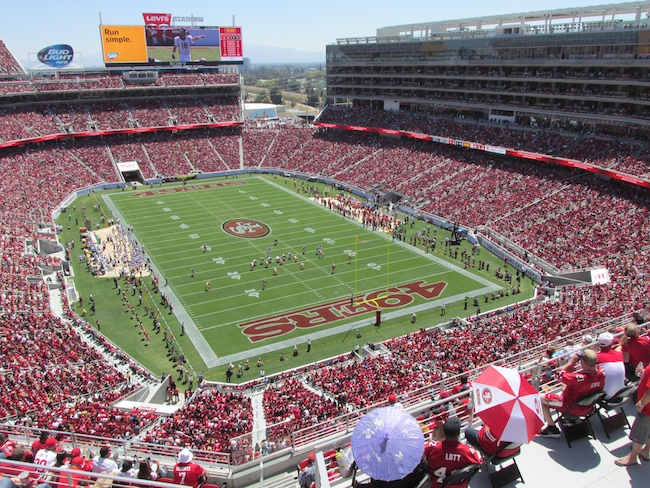
While San Diego’s City Council, tourism officials, hotel owners and the Chargers debate over land to expand the Convention Center and also build a new football stadium, the 49ers recently christened Levi’s Stadium in Santa Clara thanks to a partnership few ever envisioned.
Santa Clara, a city of 120,000 residents in Silicon Valley located 38 miles south of the 49ers’ former home at Candlestick Park in San Francisco, lured the team largely because existing infrastructure was already in place to support nearly 70,000 fans coming to and from a typical football game.
But to hear Moore tell it, the biggest factor was that all stakeholders — councilmembers, tourism officials, hotel owners and the team — could envision the future benefits once the stadium opened. A majority of Santa Clara taxpayers shared the same vision too, voting in 2010 to approve the lease of city property to build the stadium.
“What it’s done for property values is astronomical,” explained Moore, now a realtor in Santa Clara that is also writing a book about his experience helping to lead the project. “That’s revenue for the city. Ultimately, what it’s going to create is a true downtown for Santa Clara.”
Two years after Moore dropped off his letter at the 49ers’ corporate headquarters, Santa Clara expanded its convention center, which is located next to Levi’s Stadium.
“We’re not a big city but [both projects] have taken us to a bigger tier,” Moore said. “Before these projects, our land across the street from the stadium had a sign on it but we couldn’t get anybody to lease the property.”
The opening of Levi’s Stadium is also spurning additional growth. For example, the Related Companies is planning to invest $2.3 billion to create a regional shopping and commercial center on the city’s existing golf course nearby. The Montana Property Group, led by football hall-of-famer and former 49er Joe Montana, plans to build a luxury hotel, office and entertainment space on land north of the stadium.
Macneil said the biggest challenges in San Francisco were how to make do with the limited amount of land available in such a high-density city – and also absorb the high infrastructure costs.
“Finding 20 acres of land just to build the stadium was not hard,” Macneil explained. “What makes it difficult in an urban environment is really the parking. You need 140 acres just for 20,000 cars and it also has to be well-served with public transportation.”
The 49ers estimated the cost just to build a new parking garage to support 20,000 cars at $600 million.
Moore, who tried luring the San Francisco Giants baseball team to Santa Clara in the late 1980s, said the San Diego City Council, Chargers and tourism officials should look into lowering costs by making the most of the existing public transportation infrastructure — as well as the limited land available Downtown — by making an expanded convention literally part of the Chargersw new stadium. He cited a recent gala event held on one of the suite levels at Levi’s Stadium.
“You know how expensive it is to put in a new bathroom or kitchen in your home, right? Why wouldn’t the Convention Center utilize this brand new existing [stadium] space?” Moore asked. “The enclosed bar and restaurant areas inside Levi’s Stadium are a lot better than a lot of convention centers I’ve seen. And they have their own kitchens and bathrooms. That would be a smart way to also help expand a convention center.”
“My experience with Petco has taught me the value of holding a meeting in the Western Metal Building or the OMNI Premier Club,” said John Kratzer, president and CEO of JMI Realty that developed Petco Park and the surrounding ballpark district. “That’s very exciting to people.”
Kratzer said a football stadium could be constructed on top of an expanded Convention Center for $1.4 billion.
One of his company’s proposed sites would be a short walk from the existing Convention Center. Such a design has never been done before. Constructing a football stadium and an expanded convention center separately would cost an additional $400 million, Kratzer said.
“The campus style approach can work, because San Diego’s greatest asset is its weather,” Kratzer said. “Comic-Con has shown that a large convention can take over multiple facilities. I don’t believe [the expansion] has to be contiguous to the existing Convention Center space.”
Dennis Wellner, founder of the architectural firm Populous that has designed more than a dozen NFL stadiums, agrees. Wellner said that the expansive restaurants, bars and lounges within enclosed club-level and suite-level stadium seating could serve multiple audiences.
“Those are going to be the most expensive parts of the building to design,” Wellner said. “Yet high-end costs such as space used for premium patrons can serve dual purposes.”
No general or enterprise funds were used by Santa Clara taxpayers to pay for Levi’s Stadium and no new taxes were added either, except for a self-imposed tax by local hotels. The city’s Stadium Authority borrowed $850 million from Goldman Sachs, Bank of America and U.S. Bank for construction, with the NFL contributing $200 million. Additional funding came from redevelopment money, which has since dried up in California and created one more challenge for the Chargers.
The NFL stadiums of the Arizona Cardinals, Indianapolis Colts and St. Louis Rams have used their field as a convention hall, but each of these facilities also has a roof.
“When I talk to the world’s leading architects, no one’s really done it right,” Kratzer said. “The real answer is no one has ever set out to make sure it works out for the team and a convention center. Our plan optimizes space for both.”
“I’m an underdog kind of guy,” Moore said. “We had to think smart.
“San Diego should think like they’re the underdog. Do something spectacular.”
Note: San Diego Downtown News reached out to Chargers spokesman Mark Fabiani; Joe Terzi, CEO of San Diego Tourism and the Mayor’s Office. None responded for comment on the story.
—Joe Connor is a freelance sports writer that has seen a game at every NFL, NBA, NHL and MLB venue. He can be reached at [email protected].


