


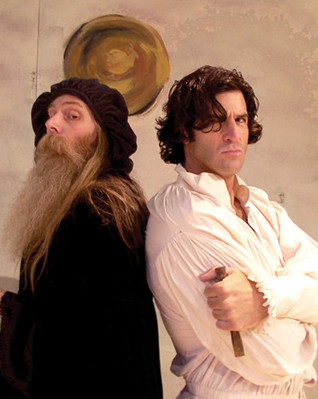
Run by artistic director Dori Salois and artist-in-residence Robert Salerno ” a married couple who lives in La Jolla ” Vantage Theatre is dedicated to producing the work of living playwrights. Staged by Salois and Salerno, a current case in point is local resident Sal Cipolla’s “The School of the World.” It is produced in collaboration with Balboa Park’s Centro Cultural de la Raza (2004 Park Blvd.).
Cipolla’s play is set in the municipal palace, Palazzo Vecchio, in 1504 Florence. It’s the height of the Italian Renaissance, and chief magistrate Piero Soderini (Steve Oliver) commissions rival artists ” young Michelangelo Buonarotti (handsome Jeffrey Lippold) and the middle-aged Leonardo da Vinci (James Gary Byrd) ” to create frescoes in the palace’s Great Hall.
The two artists have an intense rivalry: Michelangelo disdainfully refers to da Vinci as “the scientist,” and da Vinci to Michelangelo as “the sculptor” “” and indeed they were those things, too. Michelangelo had just finished his masterpiece sculpture, “David,” and was soon to be coerced by Cardinal Fianco (Eric George) to create the magnificent frescos on the ceiling of the Sistine Chapel for Pope Julius II (Jonathan Dunn-Rankin).
Due to his abrupt departure for Rome, Michelangelo’s depiction of the Battle of Cascina was never completed and was lost. According to one source it exists behind a later fresco, separated from it by a few centimeters, a theory that remains to be seen. Da Vinci’s “Battle of Anghiari” was ruined. The artist experimented with a new type of oil-based pigment and as he hurried the paint’s drying process with charcoal braziers, the top portion collapsed onto the bottom. This work, too, is lost.
After a long setup rife with Soderini’s bumbling advisors (over-the-top acting and physical comedy) and seemingly interminable jousting between the rival artists with pompous verbosity and paintbrushes, the play settles down to some compelling speeches, for instance, that of Michelangelo regarding his “Pieta,” and that of Pope Julius II regarding his legacy in art, the latter ironic because the legacy will be lost to posterity.
The introduction of Fabius, da Vinci’s innocent “boy” (beautifully played by Tyler Jaymes Albright), lifts the play by introducing humanity and poignancy, and so does the genuine respect and borderline affection that develops between the master artists as da Vinci seeks to foil Cardinal Fianco’s attempts to find and abduct Michelangelo before he is able to complete his fresco. Granted, da Vinci’s motive is self-serving, but that’s another facet of a genius that apparently didn’t hesitate to risk others’ lives in carrying out his experiments with advanced technology.
To his credit, Cipolla provides the leading actors an opportunity to develop character. Both will likely grow during the play’s run. The performance of Ivan Harrison in the small role of Soderini’s aide, Francesco, is blessedly understated and should be exemplary to some of the others, who act too hard and grimace. Harrison’s stillness speaks volumes.
The play and the actors work well in the cavernous Centro, overcoming the acoustic, which tends to diffuse voices and obfuscate diction. Production values suggest Renaissance Florence as well as the developing frescos.
Those who are interested in new work and in art history are urged to see this fascinating new work at 8 p.m. Thursdays through Sundays, through June 9. It is rife with potential. Tickets are $15 to $20 and may be reserved by calling (619) 235-6135.


