


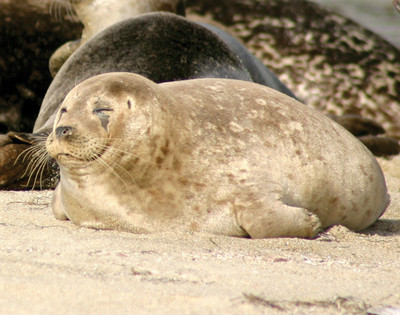
The Children’s Pool has been the subject of not only a local controversy between seals and swimmers but a legal debate as well. The latest ruling by the Fourth District court of appeals upheld a ruling, forcing the city to clean up bacteria levels at the pool and to dredge the swim area in order to restore it to its 1941 condition.
And it seems the seals maintain the spotlight, no matter the issue at hand when it comes to the Children’s Pool.
“I say let the kids vote on the seal issue. The [seals at the] Children’s Pool are something every city would love to have, and we spend all this money trying to get rid of them,” said Tom Smith, a sidewalk artist in Casa Beach area. “I’ve been here for 11 years painting, and I’ve never heard a single kid complain about not being able to go swimming there. They want to see the seals.”
Smith’s opinion is one of many in the ongoing dispute that began in 1992, when harbor seals decided to make the Children’s Pool their home. But the argument may be moot now, thanks to a Sept. 7 ruling by the Fourth District court of appeal that began when swimmer Valerie O’Sullivan brought her suit.
“The main relief we were seeking was to get the beach back to a condition for swimming,” said La Jollan Paul Kennerson, an attorney for O’Sullivan.
On a Sunday morning at the Children’s Pool off Coast Boulevard, tourists walk past a table filled with seal souvenirs. Many stop to buy a seal shirt or stuffed seal for their child before they walk down a long jetty to view the seals. “We’re here to see the seals,” a group of out-of-towners said.
Both seals and tourists seem oblivious to the tumultuous effects of the marine mammals. Signs in place that warn of the consequences of disturbing the seals frightened the city, it has claimed in court, into ignoring the built-up sand in the Children’s Pool. This caused poor drainage into the ocean, resulting in pollution from the seals’ waste.
“Nobody’s trying to hurt the seals,” Kennerson said. “A former SeaWorld employee testified that the seals will probably move to Seal Rock after being displaced for four or five days, where they’ve ‘hauled out’ for decades.”
To remove the sand and clean the water, the court has ordered the city to dredge. District 1 City Councilman and Council President Scott Peters’ office said the money for dredging is merely a drop in the bucket compared with the amount to continue the appeals process.
“At this point, no one knows if the dredging will occur, or if the city will continue to appeal,” said Peters spokeswoman Pam Hardy. “I think we’re all still waiting to see. We are required to comply with the ruling.”
Ellen Browning Scripps could never have imagined this controversy when she completed construction of a concrete breakwater to create part of the Children’s Pool in 1931, and donated it to the city. Eventually, her donation, along with a trust from the governor consisting of the tidal and state lands, became what is known today as the Children’s Pool in its entirety “” a trust to be used under certain conditions for public recreation.
“The key point is that the property is a trust property,” Kennerson said.
O’Sullivan’s lawsuit arose when she swam with nine others from La Jolla Cove to the Children’s Pool. When she walked onto the beach, she “flushed the seals,” making them scatter. It is against the Marine Mammal Protection Act to interfere with the seals, and when O’Sullivan was cited, she sued the city, said Rachael VanderWalde, education and policy director for the Animal Protection/Rescue League’s La Jolla Seal Campaign.
San Diego Superior Court Judge William C. Pate ruled in O’Sullivan’s favor. He also awarded O’Sullivan $468,906 in attorney’s fees and an additional $10,941 in costs. He gave the city six months to restore the Children’s Pool to its original 1941 condition. The city was told to remove the sand build-up and reduce the contamination in the water to levels safe for humans. The city immediately appealed.
“I made them an offer to forgive a part of the [attorney’s] fees,” Kennerson said. “But, it looks like it’s going to run the normal course.”
The Fourth District court upheld Pate’s decision. The city argued many points to no avail, mainly that “the language of the trust written by the legislature is clear and unambiguous.” The city unsuccessfully argued the trust clearly permits both seals and humans at the Children’s Pool, for recreational purposes, which it has been complying with by allowing humans to view the seals.
Peters has been against the appeals process, but for joint use at the Children’s Pool, Hardy said.
The State Supreme Court upheld Pate’s entire decision in favor of O’Sullivan. It will cost the city between $250,000 and $500,000 to dredge the sand that has built up at Children’s Pool, plus an additional $50,000 every three to five years.
“That money would need to come out of the parks’ budget,” Hardy said.
All sides are now waiting to see if the case will continue to be appealed at the next level.


