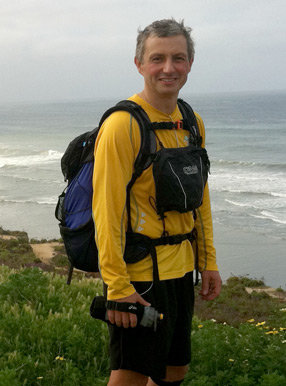
Raymond Stevens is taking fundraising to a new level. The Scripps Research Institute (SRI) professor, who heads the Stevens Laboratory at the campus, will be running for a cause — across the desert. Stevens will participate in the Marathon des Sables, a six-day, 156-mile ultra marathon that starts in Morocco on April 3 and treks the distance of six regular marathons through a section of the Sahara Desert. Stevens’ cause is PKU, a genetic disorder that occurs when the body is unable to break down the amino acid phenylalanine. Stevens has been at the forefront of research into treatments for PKU since his interest in the disorder was piqued as a starting assistant professor at the University of California, Berkeley 20 years ago. Now at SRI, his laboratory is helping with the development of a molecule that degrades phenylalanine so the body can easily get rid of it. In a blog on the website www.PKUHeroes.org, Stevens has written about his decision to participate in the run and his challenges along the way. In response to the most common question he encounters — “Why?” — he writes, “I have three young children of my own, and I want to set an example for them that one can do anything they set their minds to. I believe one should live life to its fullest. Life is too short not to make the most out of every single day.” Stevens wrote that he has been running long distances while carrying a 20-pound backpack and exercising in a dry, 130-degree sauna to prepare for the race. Runners have to carry their own supplies across the desert, including food. The course is not revealed to the runners until the day before it begins to prevent participants from unfairly practicing in advance. On March 27, Stevens wrote that he was en route to Morocco. Unfortunately, he wrote, he developed acute shin splint pain while traveling, so will start the race “a bit damaged.” He is, however, still in the race. “I am up for the challenge, which is easy to say now while I sit in a comfortable hotel room typing,” he wrote. “Next week when I am trying to sleep on sand in freezing temperatures, after running on hot coal-like sand I will be thinking something else.” Stevens, who was accepted into the race through a lottery system last September, said he didn’t tell anyone about it until late December, just in case he decided to back out. Indeed, as he wrote, running long distances is 50 percent physical and 50 percent mental. “I will continue with the analogy that running this race is like developing treatments for PKU,” he wrote. “Three steps forward, two steps back, but one just has to keep moving forward and eventually one WILL cross the finish line.” Starting April 3, supporters can through a GPS tracking system. To follow Stevens on his journey, go to www.PKUHeroes.org or www.dar- baroud.com.