


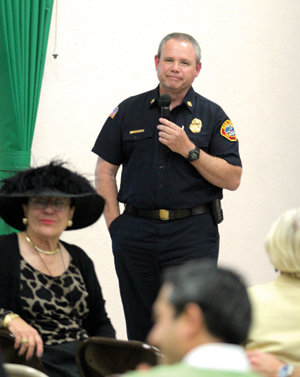
The diminishing fire department budget affecting fire stations throughout San Diego, and at La Jolla’s three stations specifically, have resulted in increased response times and may lead to a greater number of preventable tragedies, said San Diego’s Fire Chief Javier Mainar at a June 10 La Jolla Town Council meeting. Mainar, who addressed the audience with a detailed presentation and video of a near-drowning at Black’s Beach in May, said that a $187 million annual budget, down from $200 million, is not sufficient to swiftly respond to the more than 300 daily and 110,000 annual calls the region receives. The inevitable response to the cuts, Mainar added, is “brownouts,” where a station shuts down fire trucks and engines on specific days and places firefighters on-call for other areas in order to minimize expenses. La Jolla’s three stations — located on Torrey Pines Road, Nautilus Street and Via Casa Alta — have not experienced brownouts, Mainar said, because each station contains only one fire engine. Mainar explained that fire engines are smaller and more capable of extinguishing flames than fire trucks, with a capacity of 500 gallons of water. Fire trucks, by contrast, are larger and contain more tools, giving them special capabilities more appropriate for medical emergencies. When forced to choose, stations tend to keep engines operating over trucks. Mainar pointed out that La Jolla may still be affected by brownouts, despite not sustaining any locally, because fewer resources anywhere results in strained capabilities in surrounding areas. “Basically, it means that help is further away,” he said, noting that units in University City and Pacific Beach experience brownouts. Since the brownouts were implemented, the response time at La Jolla’s Station 13 stayed roughly the same but Station 16 recorded a 30-second increase on average. Station 9 actually slightly improved its response time. Mainar said that the department has been called to respond to more medical emergencies in recent years, rather than strictly fire-related incidents. “Our mission has changed,” he said. “Eighty-two percent of our calls are medical. The response time is critical in these instances because 30 seconds can literally mean the difference between life and death.” Mainar added that the budget cuts have affected lifeguard services as well, resulting in a recent incident at Blacks Beach in which two women and a male surfer nearly drowned. The pressure to respond quickly to fires is just as high, with the most dangerous “flash point” typically occurring around the 8-minute mark. “We strive to get there before then because fires grow geometrically,” Mainar said. “If you’re in a building on fire at the flash point, you’ll likely die.” In order to meet the national standard of a 5-minute response time for 90 percent of incidents, Mainar said, 11 to 22 more stations are needed throughout the city. “The reality is, we have a 5-minute response time for only 54 percent of calls,” he said. “The implications of that statistic are serious.” Each brownout saves about $1.4 million per unit annually, Mainar said. “These cuts can’t be restored without additional revenue sources,” he added. Mainar urged audience members to familiarize themselves with city services, communicate with elected officials, and contribute to charitable organizations in efforts to keep the city safe. SAN DIEGO FIRE DEPARTMENT • Number of La Jolla fire stations: 3 • Number of stations citywide: 40 • Locations: Station 9, 7870 Ardath Lane Station 13, 809 Nautilus St. Station 16, 2110 Via Casa Alta • Annual department budget: $187 million, down from $200 million • Number of positions: 1,067 • Number of incidents: 300+ daily, 110,000+ yearly • 82 percent of calls received by the department are medical-based, not fire-related


