


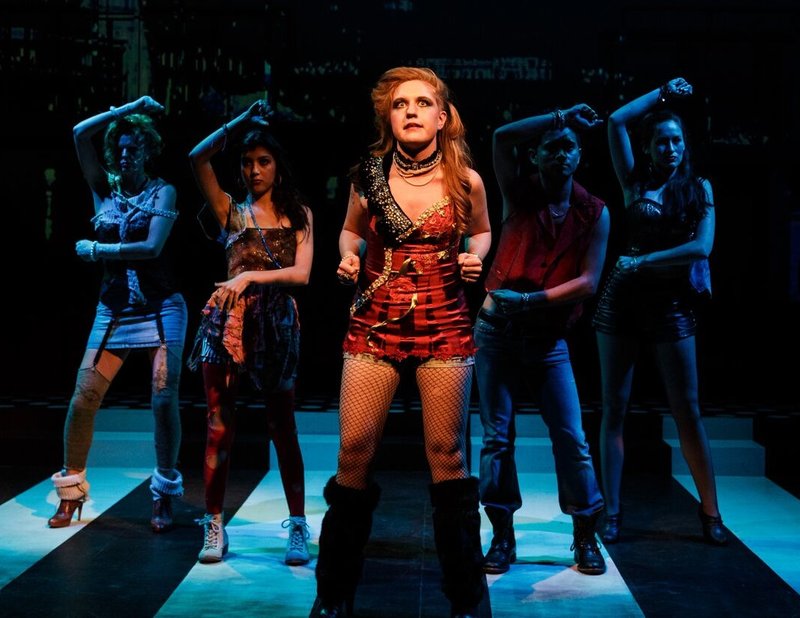
This week, I’d like to concentrate on sound and projection (double entendre the latter). Apparently, the projection gods demand appeasement this spring. First, we dealt with the failure of technology throughout San Diego Opera’s April 25 afternoon performance of “El Pasado Se Nunca Termina” (“The Past Is Never Finished”) at the Civic Theatre. Many sat in the dark missing the usual English projections and wishing they’d paid better attention in Spanish class. On May 8, the second act of kallisti ensemble’s “The Threepenny Opera” at the Experimental Theatre in UCSD’s Conrad Prebys Music Building, which closed May 10, suffered a similar fate. After a few sputtering attempts at projecting the background, the computer and/or computer technician merely gave up. Reminds me of the opening of the old Festival Theatre at the Old Globe. Computer-generated lighting cues were in their infancy and failed, so on opening night, director Jack O’Brien and his lighting designer had to input the cues manually. Imagine that! Computer technology is far from perfect, and due to many factors, so was “The Threepenny Opera,” the story of a Victorian Englishman who constantly eludes his father-in-law’s efforts to have him killed. First, there is the Experimental Theatre itself, which has now been modified with metal strips that run along the base of seatbacks, making the already stingy legroom unbearable. One used to be able to stretch one’s legs under the seat in front. No more. And even though the seats are padded, they grow hard over the course of 2½ hours. Second, we have the acoustical problem presented by the Experimental Theatre, in which sound, even though amplified, flies off into the high ceiling and wings of the wide playing space. Third, with book and lyrics by Bertolt Brecht and music by Kurt Weill, content in the form of text in this Weimar Republic opera from 1928 is of prime importance. The composition of the orchestra – very brassy – is a factor too, especially here. The young sopranos’ diction was largely unintelligible, whether spoken or sung, contributing to the work’s dizzying events. In some cases, text intentionally mispronounced in Marc Blitzstein’s 1954 English translation for the sake of rhyme was not. With the exception of Jonathan Nussman as Mack I, director Ruff Yeager as Peachum, producer Susan Narucki as Mrs. Peachum and mezzo Julia Karis as Lucy Brown, most everyone was not understood, making for a long evening, backside endurance notwithstanding. Then there was the matter of two Mack the Knife portrayers. I am certain there were aesthetic and practical reasons for this, but I fail to imagine what they were. Cortez L. Johnson as Mack 2 is physically agile and does not sing. Jonathan Nussman’s Mack 1 narrates and sings, at first spread and under pitch; but improved as the evening progressed. Even Michael Mizerany’s choreography could not a style re-create, and I went home feeling sorry for those who have never seen or heard a proper “Threepenny” production – something more and more rare, since Weill is seldom performed these days. Perhaps the difficulty of attempting to capture its style is the reason why. It’s interesting to note that Karis’ biography was omitted from the printed program, as was Lotte Lenya’s at the original performance. Maybe the program gods need appeasing, too, after all this time. If you are inclined to do some research, go to www.threepennyopera.org. Meanwhile, the incredibly philanthropic Conrad Prebys will receive an honorary doctorate from San Diego State University on Wednesday, June 3. Somehow, he just never had time to go to college. I’m sure he is thrilled.


