


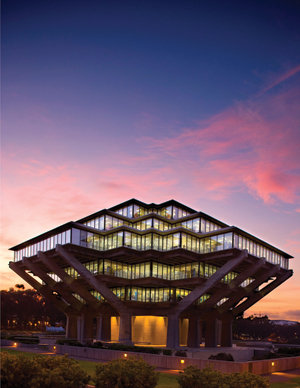
When Stanley Chodorow came to teach history at the University of California, San Diego in 1968, the campus area consisted of grass, bushes and fields of, well, nothing. “It was just snakes and rabbits up there in UTC,” said the emeritus professor, who still teaches at the university. “When it rained, it was just a big mud field.” UCSD celebrates its 50th birthday this year, and the institution has come a long way in terms of visual appearance. What began as a compact, bucolic research institution in 1960 has developed into a nearly 30,000-strong university with not only a repertoire of scientific achievements, but an adventurous architectural style that has gained the attention of a leading design book publisher. The Princeton Architectural Press recently released “University of California, San Diego: The Campus Guide,” a photography-driven book that details the evolution of UCSD’s look over the years. “The book is a compendium of UCSD’s history, architecture and legacy,” said Boone Hellmann, UCSD’s head architect. “It’s a nice way to put everything into a box and tie a book around it. It’s like a photo album of the university’s life.” UCSD is also kicking off “UCSD by Design,” a year-long series of lectures and discussions, on Sept. 30. Hellmann is, in large part, the man behind the bricks and mortar. He came to work at UCSD 25 years ago, when the campus was getting ready for its first big push in construction since 1960. For Hellmann, UCSD was somewhat of an open palette. He was charged with bringing a level of architectural quality that hadn’t previously existed uniformly, and he said he looked to “Jeffersonian ideals” for inspiration. Thomas Jefferson was not only the nation’s third president, but an architect who designed the University of Virginia. “Just as students are educated through books and interaction, they are also educated by qualities in their physical environment that they will carry on with them after graduation,” Hellmann said. “They may end up on a planning commission in their hometown where they may have to consider things from their learning experience.” For instance, Hellmann said, campus gathering sites such as Library Walk, the engineering courtyard and the iconic Geisel Library serve purposeful functions and are conducive to both social and visual appeal. The university’s design is also a reflection of the modern era in which it evolved — a time characterized by abstract art, moon landings and contemporary counterculture. “It was also an era, for students, in which it became clear that low grades would end you up in the Army,” Chodorow said. Of UCSD’s early days, Chodorow recalls a camaraderie between students and professors who were “rolling with the punches and taking a risk” in dedicating themselves to a new university. New professors quickly became involved in university administration and the founding of departments, and the invested interest has kept many at UCSD throughout the years. As for students, UCSD officials tried to appeal to those who were serious intellectually. “When students applied to both San Diego and Santa Barbara, you could assume they just wanted to be on the beach,” Chodorow said. “So, we said Santa Barbara had the better beach — which isn’t true.” The “UCSD by Design” project will bring together art historians, architects and community leaders in celebration of the university’s 50th birthday. Each event consists of a Thursday evening keynote lecture at the Museum of Contemporary Art San Diego and a moderated discussion among experts the following morning at UCSD. The Exhibition “Modern UCSD: Celebrating 50 years of Campus Architecture” will be on display until Dec. 3 in the UCSD Arts Library, located on the ground floor of the Geisel Library. For more information on the exhibit, call (858) 534-3361. Details about UCSD’s 50th anniversary can be found at www.50th.ucsd.edu. UCSD 50th anniversary upcoming events • Sept. 30 at 7 p.m. — UCSD by Design lecture: Kurt W. Forster, founder of the Getty Center for the History of Art and the Humanities, Sherwood Auditorium, Museum of Contemporary Art, 700 Prospect St., free • Oct. 1 at 10 a.m. — UCSD by Design moderated discussion: Kurt W. Forster, UCSD Student Services Center Multipurpose Room, corner of Rupertus Way and Myers Drive, free • Oct. 2 at 7 p.m. — Bay Area Alumni 50th anniversary Night in Napa, Castello di Amorosa Castle and Winery in Calistoga, information at [email protected], $50 • Oct. 11 at 7:30 a.m. — Institute for Genomic Medicine Inaugural Symposium: Keynote Eric Green, M.D., Ph.D., National Human Genome Research Institute director, Atkinson Hall, corner of Voigt Drive and Equality Lane • Oct. 22 at 12:15 p.m. — $50K for 50 years: 15th annual 5K Run/Walk for Scholars, UCSD North Campus Field near RIMAC, more info at http://5k.ucsd.edu/ • Oct. 23 at noon — Homecoming and Family Weekend Barbeque and Beer Garden, UCSD Warren Field, $10 (free for athletes) • Oct. 28 at 7 p.m. — Helen Edison lecture: Henry Louis Gates, Jr., director of the Harvard University W.E.B. Du Bois Institute for African and African-American Research, UCSD Price Center Ballroom West, 9500 Gilman Drive, free • Oct. 28 at 5:30 p.m. — Physical Sciences 50th Anniversary Lecture: Apollo Legacy, physicist Tom Murphy, UCSD Natural Sciences Auditorium, corner of Scholars Drive and La Jolla Shores Drive, free • Nov. 4 at 7 p.m. — UCSD by Design lecture: art historian John Walsh, Sherwood Auditorium, Museum of Contemporary Art, 700 Prospect St., free • Nov. 5 at 10 a.m. — UCSD by Design moderated discussion: art historian John Walsh, UCSD Student Services Center Multipurpose Room, corner of Rupertus Way and Myers Drive, free


