


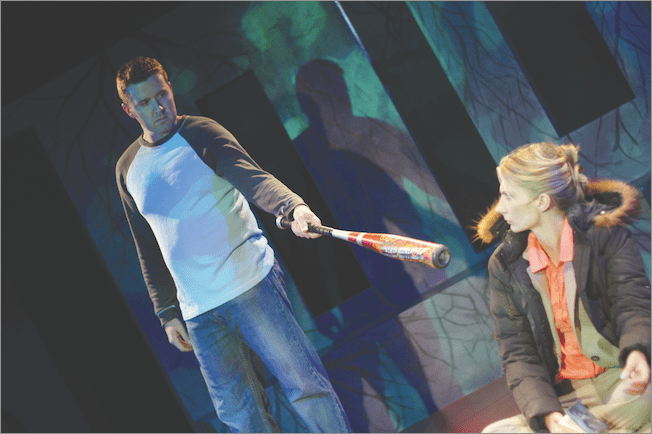
“The Mystery Plays”
Where: BLKBOX at ion theatre, 3704 Sixth Ave., Hillcrest
When: Through Sept. 15; Thurs. and Fri. at 8 p.m., Sat. at 4 & 8 p.m.
Info: 619-600-5020
Web: iontheatre.com
Two suspenseful productions in ‘The Mystery Plays’ are perfectly directed and acted

By Charlene Baldridge | SDUN Theater Critic
Everyone loves a well-told thriller or two, especially if there are laughs to relieve the suspense and horror.
Opening ion theatre company’s seventh season, “The Mystery Plays” is so delicious that the witness wishes the two tales therein would never end. But end they do, so dark and darkly funny, and so perfectly directed and acted that the real world the viewer must reenter seems comforting, yet bizarrely unreal. You’ll want to return again and again to ion, savoring the inter-related stories and the amazing dream team ensemble comprising Sherri Allen, Benjamin Cole, Gemma Grey, Nick Kennedy, John Polak and Ethan Tapley.
Written by award-winning playwright, comic book and television writer Roberto Aguirre-Sacasa – who is currently working on “American Psycho the Musical” with Duncan Sheik – “The Mystery Plays” borrows from the medieval mystery tradition and from the works of master storytellers Alfred Hitchcock, Franz Kafka and H.P. Lovecraft. Throw in influences from James Lapine and Stephen Sondheim as well.
In the first play, titled “The Filmmaker’s Mystery,” a young screenwriter named Joe (Tapley) is seated on a train, traveling from New Haven to Newport News for a family holiday. Nathan (Cole) joins Joe and, in the process of coming onto him, reveals certain things about himself, including that he’s a neurologist with an avid interest in an ancient Greek physician who dissected brains looking for the soul.
Joe leaves the train at Wilmington. He knows not why. The train pulls out sans Joe and burns after leaving, incinerating every soul aboard. Visited repeatedly by Nathan’s ghost, Joe is subject of a police investigation. He sets out to explore Nathan’s life and the possible reasons for his own survival.
In the second play, “Ghost Children,” Joe’s attorney, Abby (Grey), catches a plane from the East Coast to her home in Oregon, where she is called to testify before the parole board in behalf of her brother (the multifaceted Kennedy), who brutally slew their abusive parents and innocent younger sister 16 years before.
With scenes then and now intercut, this tough play explores Abby’s reluctance to forgive her brother. How could she? Would you? But it is much more complicated than that. Adding a bit of levity as the parole board’s limo driver is Cole, whose character, a Medford bumpkin, is polar opposite to the sophisticated Nathan.
It’s extraordinary, in the course of one evening, to see this ensemble stretch to play numerous, complex roles without benefit of wigs or costume changes. With his commanding voice and authoritative diction, Polak proves invaluable as narrator, police investigator, mysterious man and general purveyor of possible horror and suspense.
Grey plays Abby brilliantly, allowing us to glimpse the woman’s wounds, self-recrimination and reluctance. Both Cole and Tapley are young actors to watch. And Allen and Kennedy are simply magnificent in all their quicksilver roles.
Aguirre-Sacasa knows when tension needs relief through humor. Director Glenn Paris deftly integrates these places in the script. The playwright also provides poetry and leitmotifs that metaphorically link the two one-act plays, which are disparate in tone and type of horror. Both are supported by Brian Redfern’s fluid scenic design, James Dirks’ sound, Karin Filijan’s lighting, Valerie Henderson’s costumes and Claudio Raygoza’s projections.


