


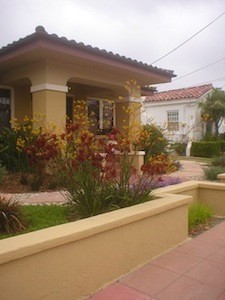
Landscape designer Raymond Shaw fell some distance from the Family Tree
By Michael Good

Raymond Shaw came to his profession—he’s been a landscape designer for the last decade—the usual way: by complete accident. It’s only in retrospect that everything seems inevitable, that graphic artist to junior high school teacher to landscape designer seems a logical progression.
In a video on Shaw’s website (produced by his son, Dana) he credits his father with his interest in design, although there’s more to the story than that. His father was a consummate craftsman (or as Shaw puts it, “He was anal about everything”). Stained glass, metal fabrication, carpentry—his father was good with his hands, a guy who was always in his workshop tinkering.
“He built furniture. He did a lot of casting. He had a centrifuge and kiln.” Shaw’s strongest memories of his father are of him in his workshop, and Shaw learning the hard way, by holding something—and trying not to get in the way. “He used to say, ‘The reason I had kids was to have an extra clamp.’ Once my mother was holding something very important for him, and as he took a backswing, he popped her in the forehead with his mallet. Of course he was more concerned about her losing her grip than he was about what he had done to her.”
While Shaw might have learned something about craft, attention to detail and dodging mallets from his father, the one thing he didn’t learn was design. Shaw said, “He was a lousy designer. He was an excellent fabricator, but not a good designer.” In a sense, Shaw learned about design by critiquing his father’s work. “He relied on pattern books for his designs, he copied junky stuff.” During the day, his father was in charge of a dental lab. “He fabricated things that went into peoples’ mouths, like bridges and crowns.”
When Shaw went to college at San Diego State University, he minored in crafts, with a glass arts focus—stained glass, enamel and blown glass. He considered majoring in sculpture, but his practical side won out. “I gravitated to advertising. I thought of myself as an illustrator, but there was so much competition,” he said. Art director seemed like a more reasonable goal. He eventually found himself designing signage for corporate clients, such as Disneyland. In a sense, he was doing illustrations—presentation drawings from a downward perspective. After 15 years, however, he was burned out. There’s a reason why they call advertising guys “mad men.”
Shaw returned to San Diego State, this time for a teaching credential, where he met his future wife, Barbara. Together, they graduated, got jobs, and began new careers—Shaw as an art teacher in a performing arts school, Barbara as a high school English teacher. After eight years, education had become almost as crazy as advertising. The back-to-basics movement closed the performing arts schools—as well as the shop, drama, dance and art classes. At the same time (it was the late 90s) the Shaws bought a bungalow in South Park. While others might have just talked about redoing the garden and house, Shaw put his thoughts down on paper, in color.
“I knew how to go about things. Working with scale. Down views and elevations. I could really see things that way. I just started drawing and drawing,” he said. Like gardening and banging on stuff with a mallet, it was a sort of therapy for Shaw. “I was so upset with education. In the end, I was saying, ‘I can’t go forward with this stress.’” He sat down with Barbara. You can imagine her looking at her stressed-out husband, the drawings everywhere and a light going on. “Why not landscape design,” she asked.
As before, Shaw returned to school, this time to Cuyamaca College. “I interviewed the head of the department, showed him my portfolio. I asked, ‘Do you think this is something I could get into?’ He said, ‘Hell, yes.’” Not only did he encourage Shaw to enroll, “but he brought me in for a project—for a sign plan for the garden where they sell plants.” Some of the classes were too basic for his skill set—such as a beginning design class—“They’re talking about the elements of design, focal points, color.” Others, such as a computer-assisted design class, didn’t fit in with his personal approach. “I have to do everything hand-drawn,” he said. In the end, he designed his own curriculum and after a year left for the real world.
Most landscape designers use the computer, but Shaw stuck with his hand-drawn plans. The approach ended up being an asset. “Most clients like to see things that are hand-drawn.” He said they appreciate the craftsmanship, the artistry and the personal touch. Do they want to keep the drawings, frame them even, like art? Shaw laughs. “It’s funny,” he says. “Yeah, they do. It’s almost embarrassing.” Almost, but not quite.
Where most designers check out after their drawings have been approved and passed on to the contractor, Shaw sticks around. “I try to be involved with the project from start to finish. I go to the meetings. I involve myself. You can’t just rely on the architect’s drawings. They’ll be out of scale. The measurements can be off. I go out to the job and measure myself.” He lays out the paths on site, and usually places the plants himself.
As far as working with the clients, he’s not above a little handholding. The teacher in him comes out. “People don’t want to be told what they want. They know what they want, but they don’t know plant material. They aren’t thinking about focal points, aspects, north-south orientation, the shadows from the arbor, where their pizza oven is going to be facing. That’s what so great about it. You come in, and it’s a brand new deal every time. I try not to repeat myself. I’m always looking at new stuff. But it’s selfish in a sense. I see something [a tree or a gate for example] and I think, I’d like to put this in my garden. After I was done with my house, I felt a big void. I live vicariously through my clients, through my projects.”
That’s not to say he’s “done” with his own landscape.
“Clients come to the house and I walk them through and we talk about plant material. People have a hard time visualizing. But it’s a small garden,” he said. “I treat it like a lab. I spend eight hours in that garden a week. I keep putting in more. Barbara says to me, where are you going to put that plant? And I tell her, ‘I’ll find a place for it. I’ll find a place.’”
For more information about Raymond Shaw, call 619-696-9179, or visit rayshawlandscapedesign.com.


