


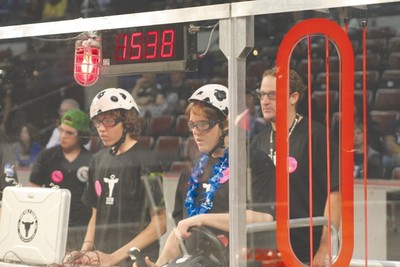
Dozens of high school students from California, Michigan, Colorado, Oregon, Idaho, Arizona and Hawaii packed the ipayOne Center for the first-ever San Diego regional event of the FIRST (For Inspiration and Recognition of Science and Technology) Robotics competition Thursday, March 22 through Saturday, March 24. The students represented the next generation of engineers, trading in bulky safety goggles for slick shades inside the chaotic arena.
Despite three years of FIRST experience, High Tech High’s team finished 30 out of 46 teams due to problems with its remote control.
This year’s challenge, “Rack ‘N’ Roll,” asked students to create robots that could successfully pick up colorful inter-tubes and place them on a 10-foot-tall rack with pegs on all sides. The first 15 seconds of play is autonomous, or preprogrammed operation, followed by 2 minutes of remote-controlled operation.
“It’s really hard to score points during autonomous play,” Todd McMahon, media coordinator for the San Diego regional competition, said.
And the rack changes position before every round, making autonomous play even harder, according to Erik Nelson, volunteer for the regional event and previous competitor and mentor for the Granada Hills Charter High School team Robodox. Nelson added that it’s all luck as to whether a preprogrammed robot is placed in the correct location.
During the lightening fast autonomous play, many robots didn’t move. This was a conscious decision for some teams, relying instead solely on remote play.
Others teams that attempted preprogrammed play haphazardly moved toward the rack and often ran into it without placing a tube on a peg.
High Tech High’s team “The Holy Cows” “” whose slogan for this year asked “Got FIRST?” “” produced a beautifully designed robot that performed below expectations.
“We had a lot of difficulties on Thursday and Friday just trying to work out the bugs,” David Berggren, teacher of principals of engineering at High Tech High and instructor for the school’s team, said.
The team finally worked out the kinks on Saturday in time for its final match.
“It’s definitely exciting, except for when things break,” Brittany Parker, High Tech High junior and director of mechanical design for the school’s team, said.
While robots do occasionally break during accidental crashes, that is not the ultimate goal. In fact, alliances can include up to three schools and are created random at each event, so teams never know whether they will be competing with or against a rival.
“It’s not like BattleBots,” McMahon said, speaking of the combat robot competition where remote-controlled armored and weaponed machines fight until elimination. “The goal isn’t to destroy.”
According to Nelson, teams will build two robots if the budget allows “” one for competition and one for practice.
“That way, they can still practice after they’ve shipped their robot,” Nelson said, as High Tech High did for the first time this year. Schools have six weeks to build their robots, which were shipped to the regional competition Feb. 20.
“As we made parts, we just made duplicates of everything,” Berggren said. The team’s second robot, dubbed the B-Bot, was used for practice leading up to the competition. “We had about a week of actual practice drive time so our drivers could just get comfortable with it.”
According to Nelson, driving accounts for a large portion of a school’s success.
“I’ve seen a lot of well designed robots fall victim to inexperienced driving,” he said of his seven years working with FIRST.
Despite High Tech High’s low standing at the conclusion of the San Diego event, the team is confident they will improve at the Las Vegas regional competition March 29 to 31 at the University of Nevada Las Vegas Thomas and Mack Center.
“We felt like we competed very well and I think we’re excited about what’s to come in [Las] Vegas with a robot that’s really working well now. I think we have a lot of practice time that’s going to pay off,” Berggren said.
While the Holy Cows did not qualify to participate in the national competition in April at the Georgia Dome in Atlanta, the team did receive the Delphi “Driving Tomorrow’s Technology” Award, which celebrates an elegant and advantageous machine feature, according to the FIRST web site, www.usfirst.org
“It was nice to win an engineering award to show that we’re a diverse team,” Berggren said.
The Beach Bot from Hope Chapel Academy in Hermosa Beach dominated the competition, finishing first at the regional event, earning them a place at nationals.
Other San Diego teams heading to nationals include The Midnight Mechanics from The Preuss School at UCSD, who received the Regional Engineering Inspiration Award, and the Devil Duckies from Madison High School for winning the Regional Chairman’s Award.


