


Ways to Work program offers families in need a dream deal
By Morgan M. Hurley | SDUN Assistant Editor
United Way of San Diego County (UWSD), a 90-year-old organization that brings local communities together, partnered with a local nonprofit to offer low-rate car loans and other financial services to local “underemployed” members of the region.

Ways to Work is a national program that offers case management, financial education, low-interest loans and other services to high-skill workers who are unemployed or working below their skill levels. Many of these workers are living at or just above the poverty line, a recent Ways to Work press release stated.
“Public transportation in our county can be limiting, and we want to help San Diegans get wherever they need to go,” said UWSD President and CEO Doug Sawyer in the release. “Ways to Work has shown a strong return on investment and high success rate, helping struggling parents improve their self-sufficiency.”
Last August, UWSD made a two-year commitment with the Leichtag Foundation of Carlsbad, Calif. to bring the Ways to Work program to San Diego. The main thrust of the program is to get fixed, low interest-rate loans for individuals with lower credit scores. The loans would serve to purchase a used, reliable vehicle, enhancing the recipient’s availability to work and contribution to their families.
The vehicles are also intended to help participants advance in their careers, reduce tardiness and absenteeism, allow them to respond more immediately to the needs of their family, and give them the opportunity to pursue further education.
“Our goal is to help those we call ‘working hard but falling short,’” said Shaina Gross, UWSD vice president of impact strategies and mobilization. “We want to strengthen families and make people more nimble and responsive.”
Gross said she has spoken to many in the community who cannot afford to live closer to where jobs are available and, in many instances, public transit is a limiting and challenging factor for them finding and keeping jobs, since it often does not run at times when jobs are available.
“Studies have shown that national participants of this program have received pay increases, promotions [and] taken on extra shifts, all because they can drive,” she said. “In addition, 82 percent have gotten off of [government] benefits. [These benefits] are supposed to be a temporary solution, not a permanent solution. A program that helps to make them more self-sufficient is ideal.”
Since August, Gross said they have offered 10 loans county-wide, but have established a first-year goal of 100 loans, so they are eager to get the word out to potential applicants. If the program does well, Gross said they expect to meet its two-year commitment and then become perpetually sustainable.
Criteria for Ways to Work eligibility is simple, Gross said: applicants must already be working with an income and have children to support. Custody is not a requirement as long as the applicant can prove responsibility. Grandparents in a supportive or caretaking role and parental workers within the LGBT community are also encouraged to apply.
“Typically we are looking for people who could not get a loan at all [or] who would need to use the ‘Pay Now’ or buy at a 25 percent interest rate,” Gross said.

Those selected will first attend financial education classes offered by two supporting sponsors, Jewish Family Services and the Community Resource Center. The two-to-three hour classes cover the requirements of the program, the client’s credit report will be gone over, a budget for the client’s household will be established and other financial assistance services will be offered.
Once the class has been completed, the application process and vehicle search will begin, which Gross said takes six to eight weeks. A handful of car dealerships in each region have committed to the program for the betterment of the community.
Uptown’s Drive Motors Superstore, located at 3380 El Cajon Blvd. in Normal Heights, is one such dealer that has signed on.
“Drive Motors understands the value of the program,” Gross said. “They have committed to keeping an eye out for cars that meet the price range, have had their inspections and to hold the cars for participants for the length of the process.”
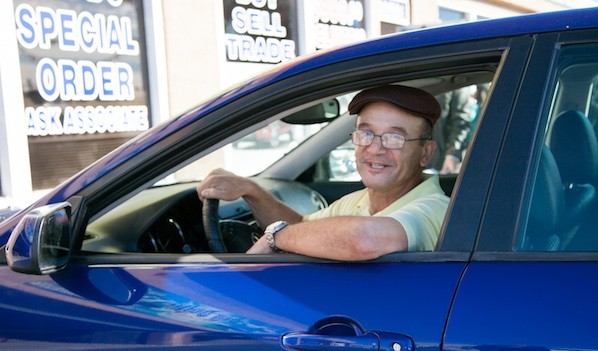
On Dec. 20, 2012, former homeless veteran Frank Martinez was the most recent participant of the program, getting an 8 percent loan for a car he purchased from Drive Motors. Martinez, who works at the Veterans Affairs (VA) office in Mission Valley, heard about the program through the VA.
“It is so exciting,” Gross said. “I feel like we’re removing a barrier and opening doors to allow people to help themselves.”
For more information or to apply, contact Jewish Family Services at 858-637-3008.


