


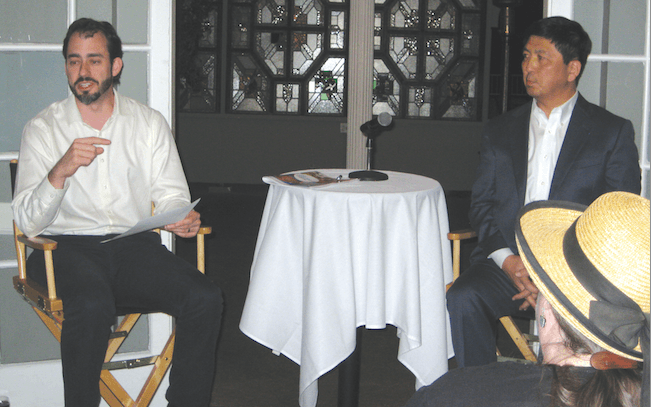
Center for Civic Engagement Vice President BongHwan Kim promotes community participation in Greater San Diego Vision
By Dave Schwab | SDUN Reporter
In a recent open-forum discussion with BongHwan “BH” Kim, the vice president and executive director of The San Diego Foundation’s Malin Burnham Center for Civic Engagement openly discussed his experience in Los Angeles politics – including racial tensions following the 1992 Rodney King riots – and, ultimately, what led him to oversee a multi-year vision for San Diego.

The San Diego Foundation, one of the region’s premiere philanthropic organizations, is currently implementing the Our Greater San Diego Vision initiative, set to guide the region’s growth over the next 50 to 100 years. Kim took the newly created position at the Malin Burnham Center August 2012, and said the Vision’s focus is on quality-of-life issues.
The Malin Burnham Center for Civic Engagement, housed at the Foundation’s Point Loma office, was initially funded by a $5 million endowment from retired real estate executive Malin Burnham. The gift was in part to help underwrite a permanent organization to maintain, promote and implement the regional vision.
Kim talked about his role in articulating that vision during the hour-long conversation with Voice of San Diego CEO Scott Lewis, held at the Top of the Park penthouse restaurant in Bankers Hill. The Feb. 28 discussion, part of the nonprofit media organization’s ongoing speaker series “One Voice at a Time,” was open to the public.
Lewis first asked Kim to explain the work of the San Diego Foundation, which was incorporated in 1975.
“There are community foundations all through the country,” Kim said, noting such foundations foster “civic engagement for public problem solving” by helping people “who want to make a difference in a more intelligent way.”
“Donors come to us who want to make a difference, and we manage their funds,” he said.
Turning to politics, Lewis asked Kim about his candidacy for L.A. City Council, to which Kim answered that he had experienced “the worst and the best of urban democracy” in his 25 years in L.A.
The worst, he said, was the Los Angeles riots in April 1992 and the backlash against Korean storeowners, which culminated in racial conflict, fire bombings and an economically destructive boycott of Korean merchants and goods.
“A few of us fluent in English had to speak,” Kim said, calling the moment his initiation into politics. “It was trial by fire that taught me a lot about how disconnected communities have become from government and the consequences of failed political leadership.”
An integral part of the Neighborhood Councils system established in L.A. after the riots as a way to support grass-roots democracy, Kim said he became convinced to run for a council seat. He was the longest-serving general manager of the city’s Department of Neighborhood Empowerment when he decided to run, and then ultimately when he resigned from the race to take the position in San Diego.
When he heard of the Foundation’s search for a director for its new Center for Civic Engagement, Kim said that it was “a pretty unique opportunity to work with San Diego government, trying to make changes from within.”
Kim said he backed the Greater San Diego Vision survey completed last year, which solicited San Diegans’ opinions on what problems they saw and what goals they wanted to achieve going forward. The results can be found at ourgreatersandiegovision.org.
“SANDAG [San Diego Association of Governments] has said our population in the next 40 years is going to increase by the size of the city of San Diego. That means the region has to accommodate 300,000 more jobs and an additional 350,000 housing units,” Kim said, adding that increases mean “a lot of challenges related to growth facing the region.”
In articulating San Diego’s long-term vision, Kim said he would like to engage public participation for future challenges by connecting the public and private sectors.
“We have to figure out ways to work with government and communities to make sure government can be as adaptive as possible to meet the challenges,” he said. “If people are given a meaningful opportunity to participate in qualify-of-life issues, they will participate. … What I’m trying to do is figure out ways in which we can do that.”


